The Anzac Memorial and Hyde Park, Sydney
Sydney's Art Deco war memorial and the park around it: free entry and 2026 hours, the 11am daily service, free guided tours, what to see inside, the Archibald Fountain and an hour's walk through Hyde Park.
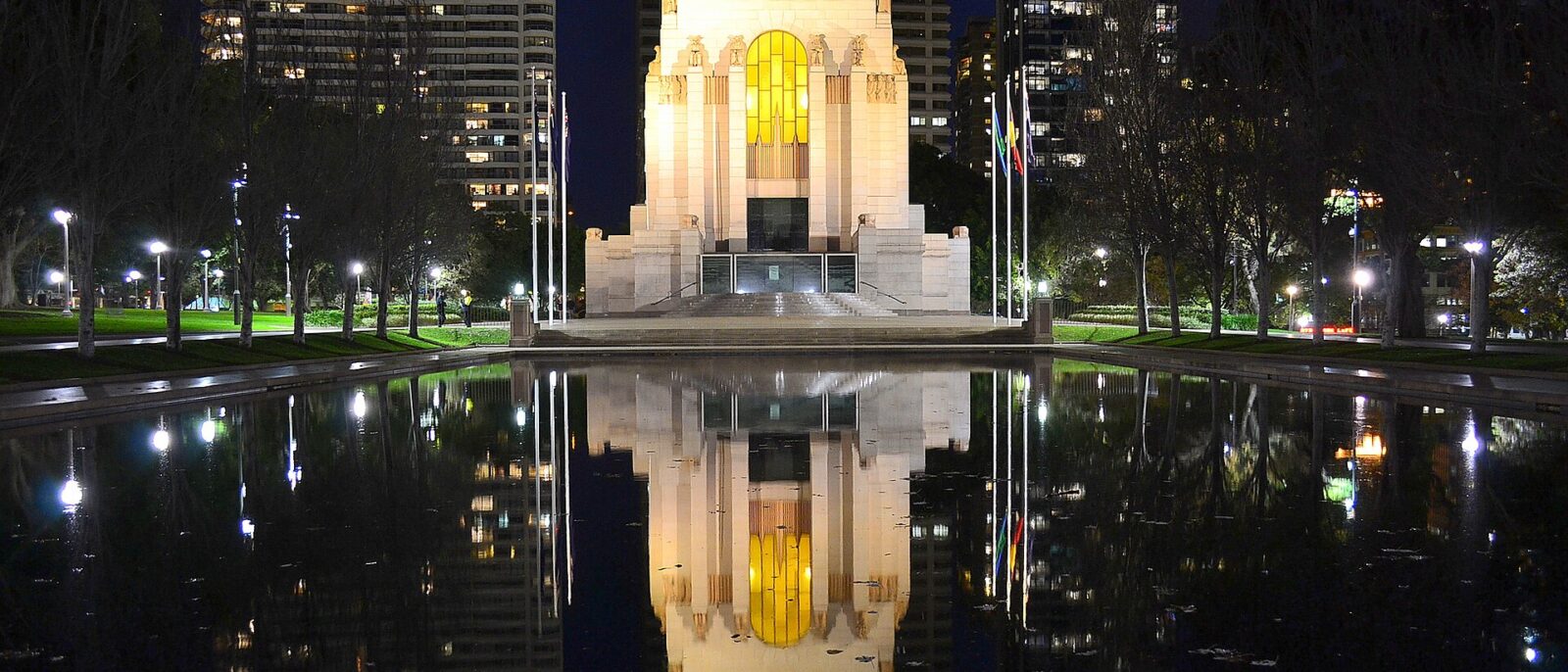
At 11 o’clock every morning, the Anzac Memorial at the southern end of Hyde Park invites its visitors to a minute of silent contemplation. Inside a tall granite building at the end of a long reflecting pool, a handful of visitors stand around a circular opening in the floor, the Last Post sounds, and someone drops a small star into the well below. The building is the Anzac Memorial Sydney raised during the Depression to honour the men and women of New South Wales who served in the First World War, and it’s a deeply affecting place. It’s also free, open every day, and a few steps from a train station, which makes it strange that so many visitors walk past it on their way to somewhere else.
This guide covers the memorial itself, what to see inside and out, the daily service and the free tours, then the rest of Hyde Park around it: the Archibald Fountain, the fig avenue, the monuments most people don’t notice, and how to link it all into an hour’s walk. Hours and tour times were checked in October 2026; treat them as the right order of magnitude, and check the memorial’s website before Anzac Day or Remembrance Day, when the program changes. For the rest of the city’s icons, see our guide to Sydney’s landmarks.
At a glance
| Detail | Anzac Memorial and Hyde Park |
|---|---|
| Where | The southern half of Hyde Park, between Elizabeth Street, College Street and Liverpool Street |
| Memorial hours | Open daily; check the memorial’s website for the day’s hours |
| Entry | Free |
| Daily Service of Remembrance | 11am, every day |
| Free guided tours | About an hour; Wednesday, Friday and Sunday at 10am, Saturday at 1pm, from the shop on the ground floor |
| Hyde Park | Open all the time and free; the Archibald Fountain is in the northern half |
| Nearest stations | Museum (at the memorial’s doorstep) and St James (at the northern end of the park) |
| Time needed | About an hour for the memorial; extra time if you walk through the park |
| Worth it? | Yes. It’s one of the best free things to see in the city |
The Anzac Memorial
Why it’s here
The memorial was built to express the collective grief of New South Wales over those lost in the First World War. Around 120,000 people from the state enlisted, and a great many of them didn’t come home. The memorial was designed by the Sydney architect C. Bruce Dellit, with sculpture by Rayner Hoff, and it opened in November 1934. It’s one of the finest Art Deco buildings in Australia: a square, stepped tower of granite, standing at the end of the Pool of Reflection, with sculpted figures on its buttresses and tall amber windows that glow gold when the lights come on inside.
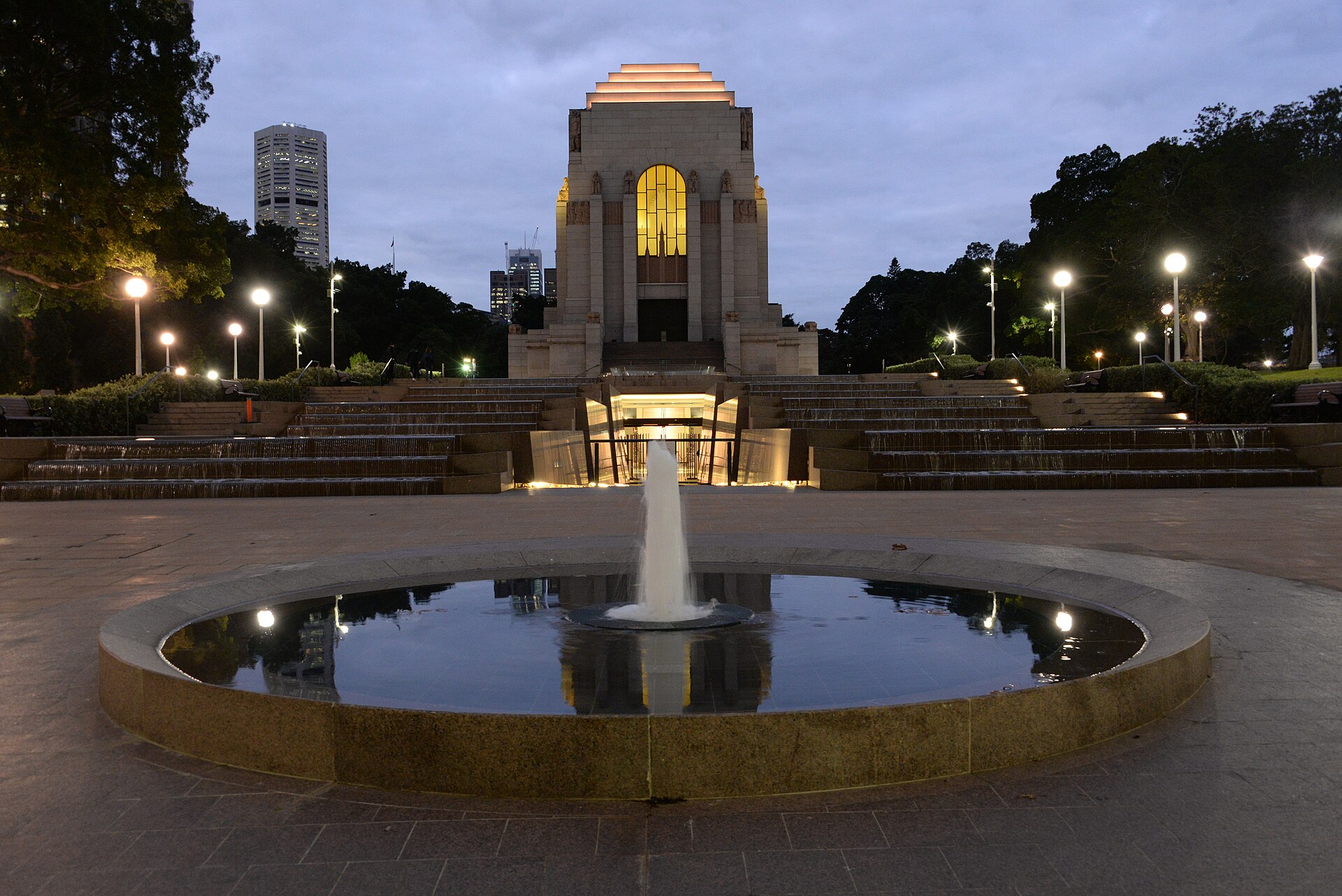
For decades that was the whole memorial. Then, for the centenary of the war, the building was extended underground, and in 2018 new halls and galleries opened beneath it. It means the memorial now tells a far bigger story than it used to, covering the service of people from New South Wales in conflicts and peacekeeping missions right up to the present day.
The outside
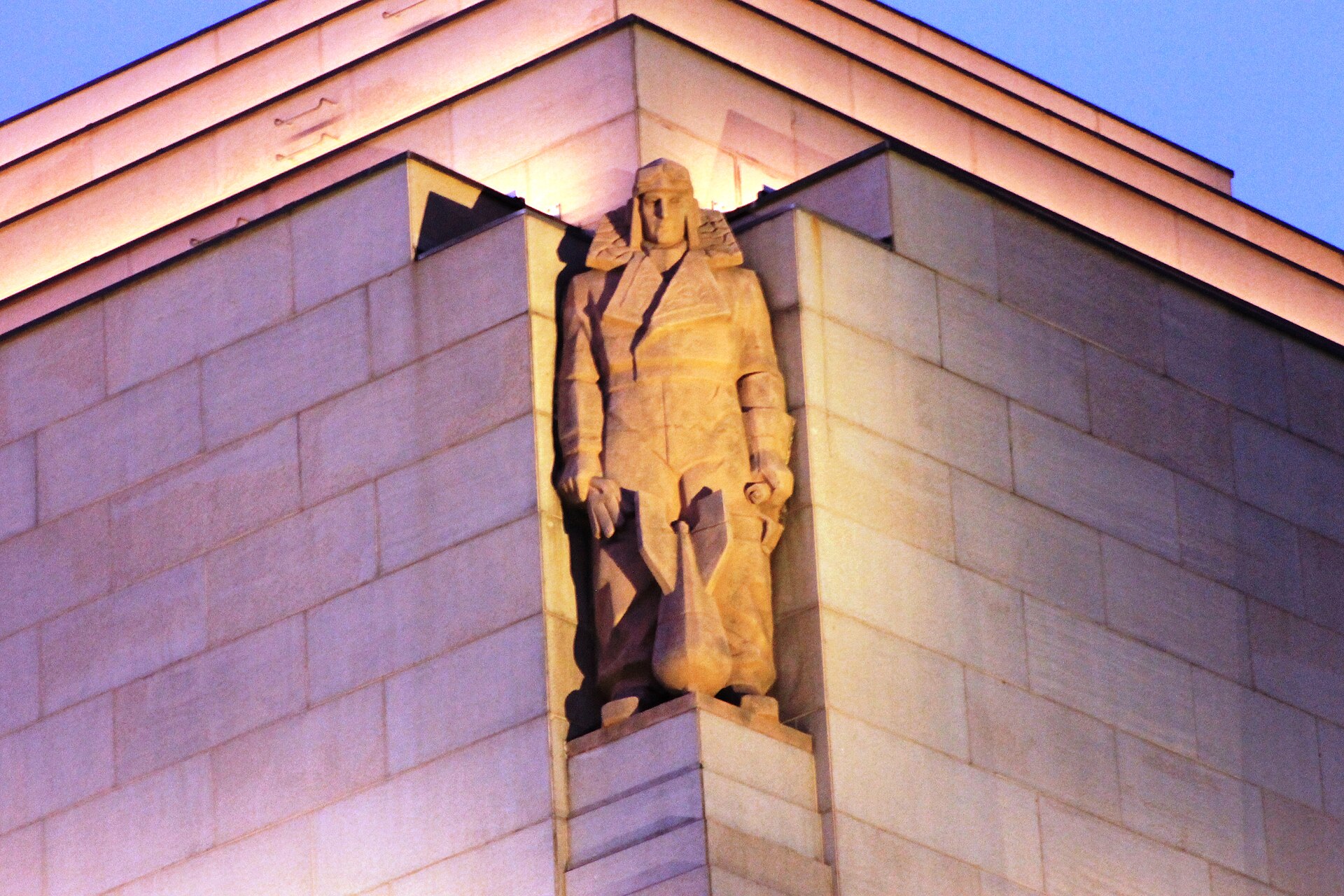
Take a slow walk around the building before you go in. The figures on the buttresses represent the people who served, and the carved panels on the walls show scenes from the war. From the northern side, the long Pool of Reflection, lined with trees, stretches away towards Park Street and doubles the building in its water. After dark, when the memorial is floodlit and the amber windows are lit from inside, the view along the pool is one of the most beautiful sights in the city centre.
The Hall of Memory
Climb the steps and walk into the Hall of Memory, the main chamber. The first thing that catches your eye is the dome above: it’s studded with 120,000 stars, one for each of the men and women of New South Wales who served in the First World War. The walls glow with the amber light from the windows, and in the middle of the floor is a circular balustrade around an opening, the Well of Contemplation. Walk up to it and look down.
The Hall of Silence and Sacrifice
Below the well, in the Hall of Silence, is Rayner Hoff’s bronze sculpture Sacrifice. A young soldier lies dead across a shield, held up by a group of women, one of them cradling a child. It’s meant to be seen from above, through the well, so that visitors bow their heads to look at it, and it’s one of the most powerful pieces of public sculpture in Australia. Many people find it more moving than they expected; don’t rush it.
The Hall of Service and the galleries
Most first-time visitors see the Hall of Memory and leave. Don’t. The centenary extension below ground is where the memorial explains itself. The Hall of Service holds soil samples gathered from more than 1,700 places across New South Wales, the home towns and suburbs that First World War volunteers gave when they enlisted, and the galleries around it tell the stories of individual people from the state who served, from the First World War to more recent conflicts and peacekeeping. The personal stories are the heart of it: letters, photographs and objects that turn the numbers into names.
The daily Service of Remembrance
At 11am every day, the memorial pauses for a short Service of Remembrance. There’s a minute of silence, a recitation of the Ode, and the Last Post and Rouse. Visitors are invited to take part: you can take a commemorative star bearing the name of an Australian serviceman or woman killed on active service, or of a veteran who has since died, and drop it into the Well of Contemplation after a moment of reflection. The service is free. If you can, time your visit for it. It’s simple, unhurried and quietly moving, and it changes how you see the rest of the building.
Free guided tours
Free guided highlights tours last about an hour and run on Wednesdays, Fridays and Sundays at 10am and on Saturdays at 1pm, leaving from the shop on the ground floor. The guides cover the personal stories behind the memorial, the Art Deco architecture and the meaning of its symbols, much of which is easy to miss on your own. A 10am tour followed by the 11am service makes an excellent morning. Group tours can be booked, and the memorial occasionally runs special after-hours tours; check its website for what’s on.
Opening hours
| What | When |
|---|---|
| Anzac Memorial | Open daily, check the website for hours; free |
| Service of Remembrance | Daily, from 11am |
| Guided highlights tours | Wednesday, Friday and Sunday at 10am; Saturday at 1pm |
| Hyde Park | Always open |
The memorial’s phone number is 02 8262 2900 if you need to check anything before you visit.
Anzac Day and Remembrance Day
Anzac Day, 25 April, is the most important day in the memorial’s year. In Sydney it begins with the Dawn Service at the Cenotaph in Martin Place, followed by the march through the city along Elizabeth Street, beside the park, and the memorial is at the centre of the day’s commemorations, with services and special free tours. In 2027, Anzac Day falls on a Sunday, and Monday 26 April is an additional public holiday in New South Wales. Remembrance Day, 11 November, is marked with a service at 11am. On both days, expect crowds and a changed program, and check the memorial’s website before you go. Our guides to Sydney in April and Sydney’s public holidays have the dates.
Hyde Park
The memorial sits in Hyde Park, and the park deserves more than the few minutes most people give it on their way from the shops to the museums. It’s the oldest public park in Australia, set aside by Governor Lachlan Macquarie in 1810 and named after its London namesake, and in the same year it hosted what’s regarded as the first organised horse race in the country. Today it’s about 16 hectares of lawns, fountains and monuments, cut in two by Park Street, with the city’s office towers crowding every edge.

The Archibald Fountain
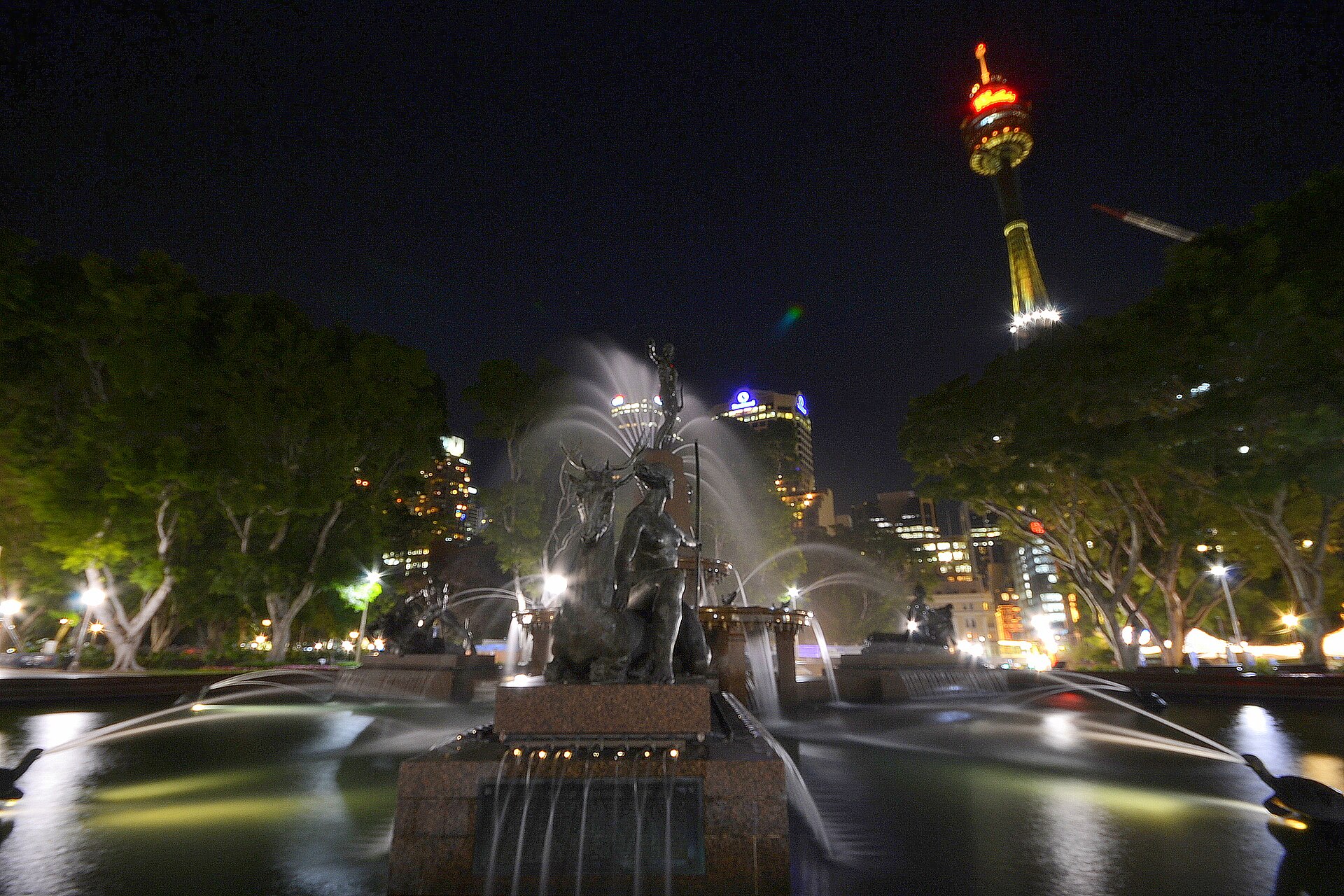
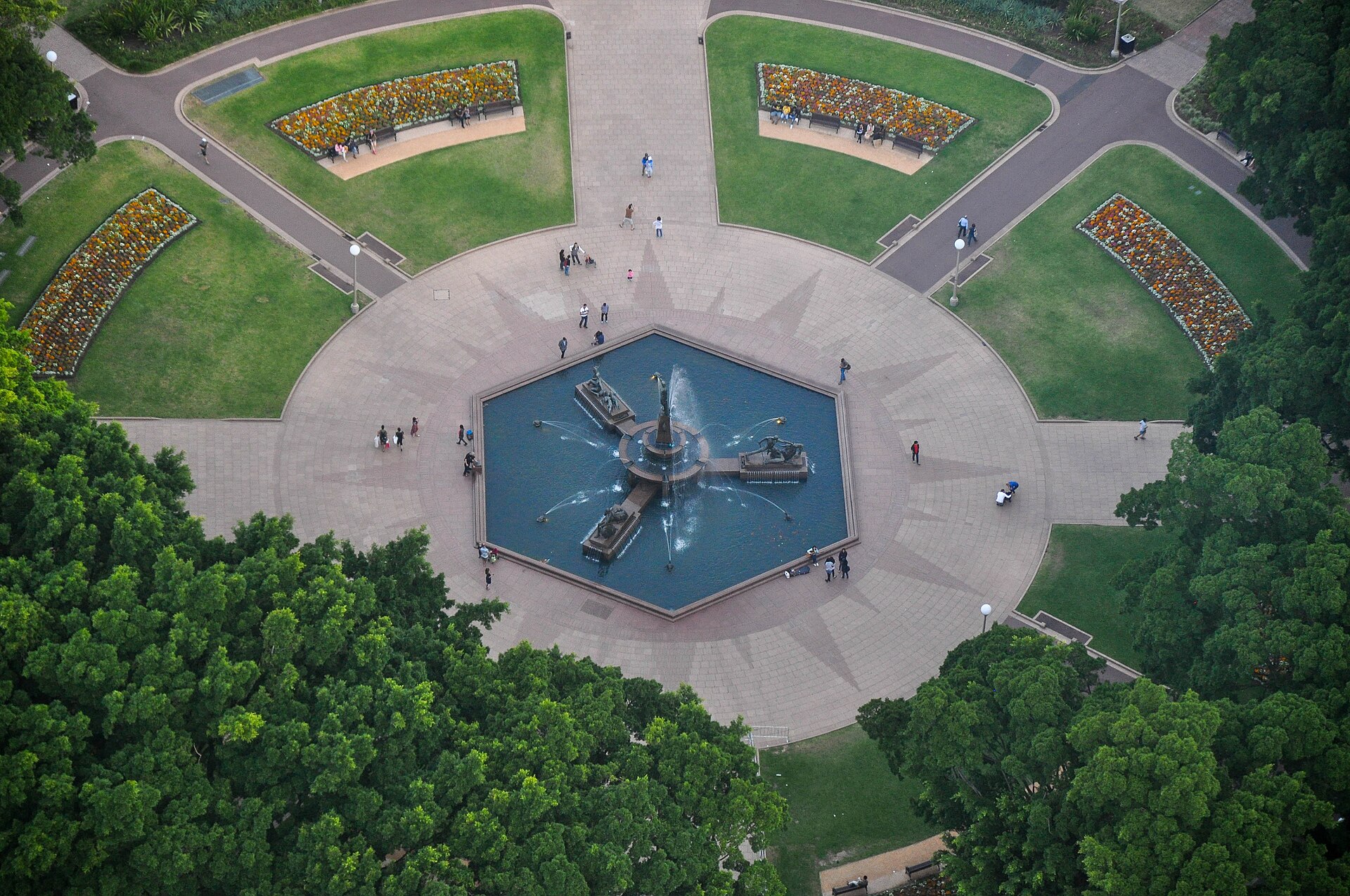
The Archibald Fountain, in the northern half of the park, is the city’s grandest fountain and its best-loved meeting point. It was a bequest from J. F. Archibald, the journalist who founded The Bulletin and whose will also created the Archibald Prize for portraiture, and he left the money to commemorate the association of France and Australia in the First World War. The French sculptor François Sicard made it, and it was unveiled in 1932. Apollo stands at the centre, surrounded by bronze groups from classical mythology: Diana, goddess of the hunt; Pan, god of the wild; and Theseus wrestling the Minotaur. It’s lovely by day, better at night, when it’s lit and the spray catches the light.
The avenue and the northern park
From the fountain, the park’s great avenue runs north to south under a canopy of fig trees, a green tunnel that’s one of the most photographed walks in the city. It’s at its best early in the morning, when the office workers are cutting through on their way in and the light comes low through the leaves. Look east from the fountain and St Mary’s Cathedral fills the view across College Street. The northern edge of the park brings you out at Queens Square, with the Hyde Park Barracks and St James’ Church on the far side of the road.
The monuments most people miss
- Yininmadyemi – Thou didst let fall, Tony Albert’s 2015 artwork near the memorial, commemorates the service of Aboriginal and Torres Strait Islander people: four tall standing bullets and three fallen shells. It’s a striking piece, and it’s worth seeking out. Our guide to Aboriginal culture in Sydney has more places to learn about First Nations history.
- The Emden gun, in the southern half of the park, was salvaged from the German cruiser Emden after HMAS Sydney disabled it in 1914, the new Australian navy’s first great victory.
- The statue of Captain Cook, by Thomas Woolner and unveiled in 1879, is inscribed “Discovered this territory 1770”, a claim that has made it a focus of protest in recent years.
- Busby’s Bore, the colony’s second water supply, was a tunnel dug by convicts to carry water from the swamps of what’s now Centennial Park to Hyde Park. It’s commemorated in the park, and the story is a reminder of how hard it was to keep the early town supplied.
- The Sandringham Garden, a small sunken memorial garden in the northern half of the park, is a quiet spot away from the main avenue.
Events in the park
Hyde Park is a starting point for the City2Surf, the 14-kilometre fun run from the city to Bondi Beach, held in August, and the Sydney Gay and Lesbian Mardi Gras parade sets off from the park before heading up Oxford Street; our Mardi Gras guide covers the best places to watch. On those days, expect closures, crowds and a very different atmosphere.
An hour’s walk through Hyde Park
The best way to see the park is on a simple walk from south to north, finishing at the city’s heritage precinct. Start at Museum station and walk straight into the Anzac Memorial, ideally in time for the 11am service. Take your time inside, including the Hall of Service downstairs. Then walk north along the Pool of Reflection, cross Park Street and follow the fig avenue to the Archibald Fountain. From there, detour east to St Mary’s Cathedral, then finish at Queens Square, where you can visit the Hyde Park Barracks or take the train from St James. It’s only about a kilometre and a half, but with stops it fills a morning. For a longer route, our Sydney architecture tour continues through the city.
Getting there
- Train: Museum station is at the south-western corner of the park, a couple of minutes from the memorial. St James station is at the northern end, and Town Hall is about ten minutes’ walk west.
- Light rail: the L2 and L3 lines along George Street are about ten minutes’ walk west.
- Bus: many buses run along Elizabeth Street, on the western edge of the park.
- On foot: from the Queen Victoria Building it’s a walk east, and from Circular Quay a walk south through the city; a route planner will give you the time from where you start.
Pay for public transport with a contactless card or an Opal card; our guide to getting around Sydney has the details.
What’s nearby
Hyde Park sits at the centre of the city, with free museums and landmarks on every side. The Australian Museum, on the corner of College and William streets opposite the park, is free to enter. At the northern end are the Hyde Park Barracks, St James’ Church and St Mary’s Cathedral, and beyond them the Domain, the Art Gallery of New South Wales and the Royal Botanic Garden. To the east, Oxford Street leads off into Darlinghurst and Paddington, and to the south-east lies Surry Hills, one of the best eating suburbs in the city. West of the park, the Queen Victoria Building and the Sydney Tower Eye are close by, and south-west of it lie Chinatown and the Chinese Garden of Friendship at Darling Harbour. If you enjoy the city’s older landmarks, Sydney Observatory, above The Rocks, is another free hill with a story.
Is it worth visiting?
The Anzac Memorial is a must, and it costs nothing. Even if war memorials aren’t normally on your list, this one is exceptional: a beautiful Art Deco building, one of the great sculptures in the country, and underground galleries that tell the stories of real people with real care. Give it an hour, go downstairs, and time it for the 11am service if you can.
Hyde Park is a pleasant walk rather than a destination. It’s a busy city park, full of people cutting through, and on its own it wouldn’t justify a trip across town. What makes it worthwhile is what’s in and around it: the memorial, the fountain, the avenue, and the cathedral, museum and barracks on its edges. If you want a park to spend an afternoon in, the Royal Botanic Garden is a better choice. For more free sightseeing, see our guide to free things to do in Sydney.
Anzac Memorial and Hyde Park FAQ
What are the Anzac Memorial’s opening hours?
It’s open daily and entry is free; check the memorial’s website for the day’s hours.
What time is the service at the Anzac Memorial?
The Service of Remembrance takes place at 11am every day. It includes a minute’s silence, the Ode, and the Last Post and Rouse, and visitors are welcome to take part.
Are there free tours of the Anzac Memorial?
Yes. Free guided highlights tours of about an hour run on Wednesdays, Fridays and Sundays at 10am and on Saturdays at 1pm, leaving from the shop on the ground floor.
What is the sculpture inside the Anzac Memorial?
It’s Sacrifice, by Rayner Hoff, in the Hall of Silence. It shows a dead soldier on a shield, held up by women, one of them holding a child, and it’s viewed from above through the Well of Contemplation in the Hall of Memory.
How many stars are in the dome of the Anzac Memorial?
There are 120,000, one for each of the men and women of New South Wales who served in the First World War.
Where is the Archibald Fountain?
In the northern half of Hyde Park, where the main paths meet, between Park Street and St James station.
Is Hyde Park safe at night?
It’s busy and well lit in the evenings, and the memorial and fountain are beautiful after dark. As in any big city park, stick to the lit main paths late at night. Our guide to staying safe in Sydney has more advice.
Which station is closest to the Anzac Memorial?
Museum station, a couple of minutes’ walk away at the southern end of Hyde Park.
Related Sydney guides
- Sydney landmarks: the city’s icons, one by one.
- St Mary’s Cathedral: across College Street from the park.
- Hyde Park Barracks: the convict story at the park’s northern end.
- Australian Museum: free, and across the road from the memorial.
- Sydney in April: Anzac Day and the rest of the month.
- Sydney culture, history and heritage: the bigger story.
- Free things to do in Sydney: the memorial and more.
Photo Credits
The Anzac Memorial and the Pool of Reflection at night: (1) Anzac Memorial Hyde Park by Sardaka, CC BY-SA 3.0, via Wikimedia Commons.
A buttress figure: ANZAC Memorial Hyde Park – 21638202194 by Mertie, CC BY 2.0, via Wikimedia Commons.
The memorial at dusk with the centenary fountain: ANZAC Memorial Hyde Park 001 by Sardaka, CC BY-SA 4.0, via Wikimedia Commons.
The Archibald Fountain at night: (1)Archibald Fountain Hyde Park Sydney by Sardaka, CC BY 3.0, via Wikimedia Commons.
The Archibald Fountain from above: Archibald Fountain, Sydney by Jorge Láscar, CC BY 2.0, via Wikimedia Commons.