Chinese Garden of Friendship, Darling Harbour
Sydney's classical Chinese garden at the quiet end of Darling Harbour: 2026 ticket prices and hours, how to read the garden, fish feeding and the teahouse, visiting with kids, and whether A$12 is worth it.
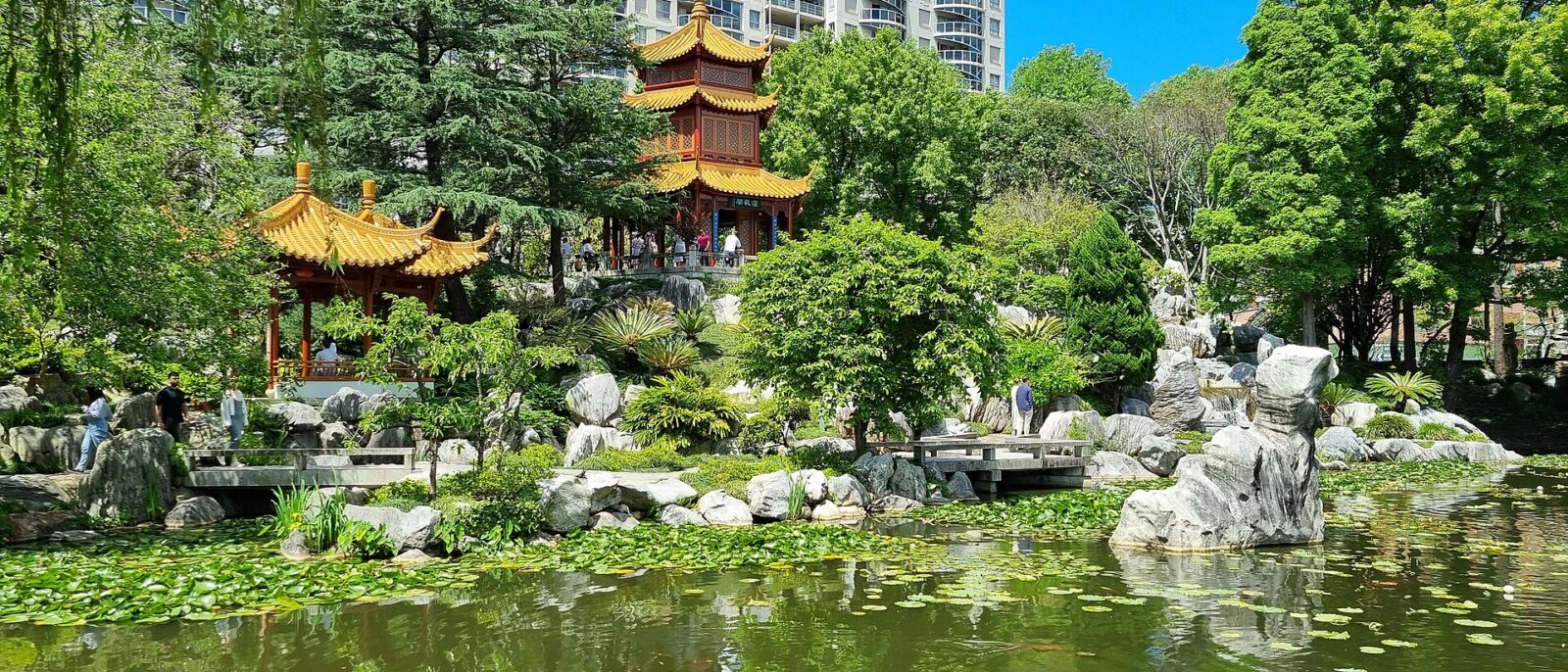
Step through the gate off Tumbalong Boulevard and the volume of Darling Harbour seems to drop by half. The traffic on Harbour Street is still there, and the apartment towers of Darling Square still peer over the wall, but inside there’s a lake full of water lilies, willows trailing into the water, a waterfall, koi drifting under the bridges and a small crowd of lizards sunning themselves on the rocks. The Chinese Garden of Friendship has been doing this trick since 1988, and it’s still one of the best places in central Sydney to spend a calm hour for the price of a sandwich.
This guide covers 2026 ticket prices and opening hours, a little of the garden’s history, how to read a classical Chinese garden so you notice what the designers intended, the main things to see, the teahouse, what’s on through the year, visiting with children, how to get there and what to pair it with nearby. Prices and times were checked on the Darling Harbour website in September 2026; treat them as the right order of magnitude. For the city’s other icons, see our guide to Sydney’s landmarks.
Chinese Garden of Friendship at a glance
| Detail | Chinese Garden of Friendship |
|---|---|
| Where | Corner of Pier Street and Harbour Street at the southern end of Darling Harbour; entrance on Tumbalong Boulevard |
| Opening hours | Daily, 10am to 5pm; last entry shortly before closing |
| Closed | Good Friday and Christmas Day |
| Adult ticket | A$12 |
| Children, concessions, seniors | A$8; under-5s free |
| Family ticket | A$30 for two adults and three children |
| Don’t miss | The lake and its pavilions, the rockery and waterfall, fish feeding at 11:30am |
| Time needed | 45 minutes to an hour; longer with tea |
| Nearest transport | Light rail to Paddy’s Markets; Town Hall and Central stations are a walk away |
| Worth it? | Yes, as a quiet hour in the middle of the city. Don’t expect Suzhou. |
Tickets and opening hours
The garden is open every day from 10am to 5pm, except Good Friday and Christmas Day. Tickets cost the same all year.
| Ticket | Price (2026) |
|---|---|
| Adult | A$12 |
| Child (under 12) | A$8 |
| Concession or student (Australian cardholders) | A$8 |
| Senior (Australian cardholders) | A$8 |
| Family (two adults, three children) | A$30 |
| Children under 5 | Free |
| Annual membership | A$58 individual, A$118 family |
Adult, child and family tickets can be bought online in advance or at the gate. Concession and senior tickets are sold only on site, because you need to show your card, and those discounts are for Australian cardholders, so an overseas seniors card won’t count. You don’t need to book ahead, and buying at the gate is fine; buying online in advance is there if you prefer to have your ticket ready. The annual membership only makes sense if you live nearby and plan to come back at least five times; for visitors, it doesn’t pay back.
A short history
The garden opened on 17 January 1988, one of the gifts of Australia’s Bicentenary year, and it was created as a symbol of the friendship between Sydney and its sister city, Guangzhou, in southern China. It was built as part of the redevelopment that turned Darling Harbour from derelict railway goods yards into the entertainment precinct you see today, and it’s modelled on the classical private gardens of China, the walled retreats that scholars and officials built to shut out the noise of the city and bring a version of mountains and lakes into their homes.
That makes it a fitting neighbour for Sydney’s Chinatown, just across Harbour Street. Chinese people have been part of Sydney since the 19th century, when many arrived in the gold rush era, and Haymarket has been the heart of the community for around a century. Our guide to Sydney’s culture and heritage has more of that story.
How to read a Chinese garden
A classical Chinese garden isn’t a garden in the English sense of lawns and flowerbeds. It’s closer to a landscape painting you can walk through, and it’s much more enjoyable once you know what the designers were trying to do. A few ideas to look out for:
- Rocks and water. They’re the bones of the garden, standing for mountains and lakes. The jagged, holed rocks are chosen for their shapes, and they’re meant to be looked at like sculptures.
- Balance. Hard and soft, light and shade, open water and enclosed courtyards are set against each other on purpose, a reflection of the idea of yin and yang.
- Concealment. Paths wind, walls interrupt the view, and you never see the whole garden at once. It’s meant to feel bigger than it is, and to reveal itself a piece at a time.
- Framed views. Doorways, windows and gaps in walls are placed to frame particular scenes, like pictures on a wall. When you pass one, stop and look through it.
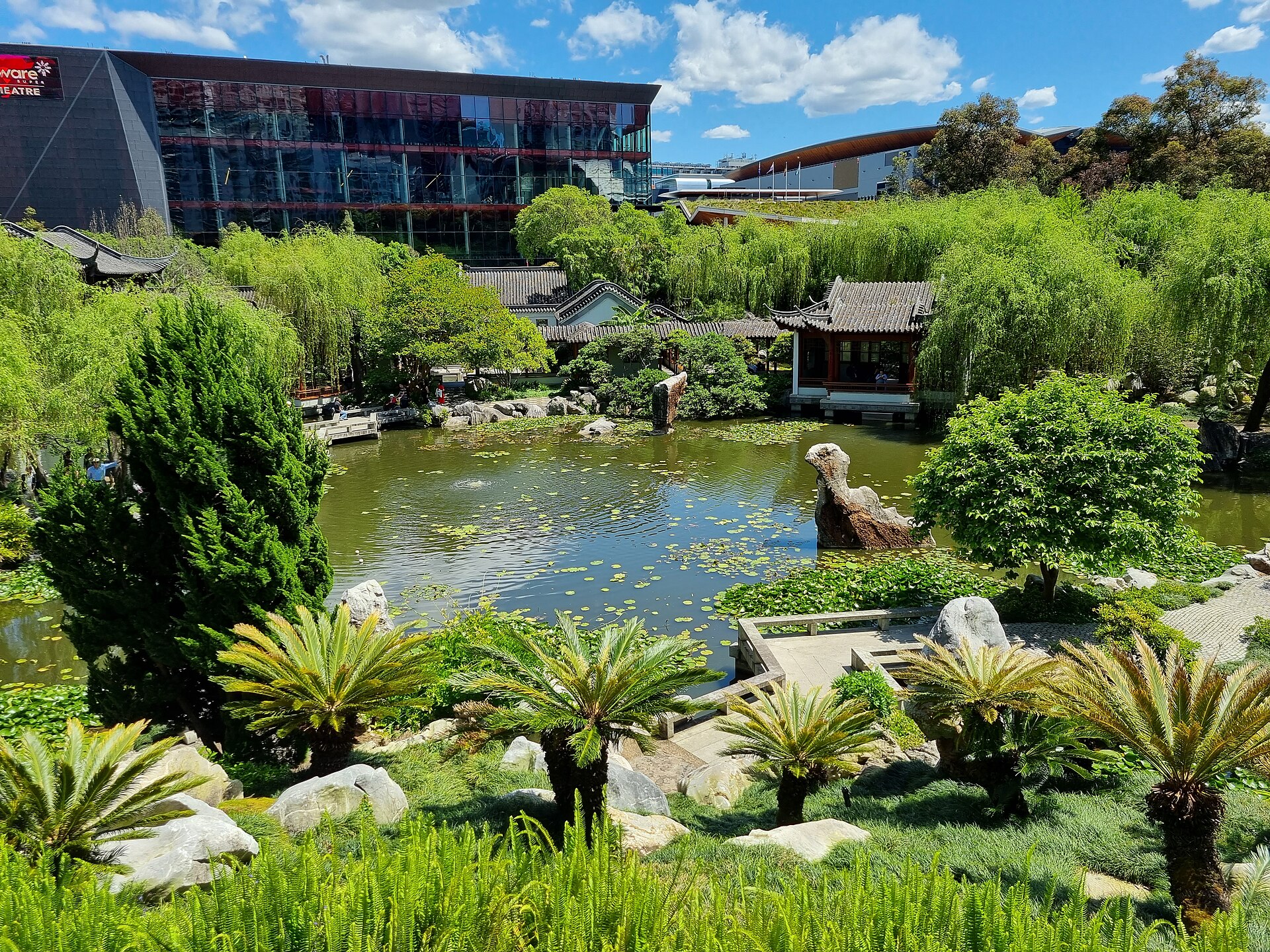
- Borrowed scenery. Traditional gardens “borrowed” distant mountains or pagodas as part of their view. Here, whether the designers liked it or not, the borrowed scenery is Sydney’s towers, and the contrast is half the fun.
What to see
The Dragon Wall
Near the entrance is the Dragon Wall, a glazed-tile wall with two dragons, one representing New South Wales and one Guangdong, the province around Guangzhou, reaching for a pearl between them. It’s the garden’s opening statement about friendship between the two places, and it’s worth a proper look before you head for the water.
The lake and its pavilions
The heart of the garden is the Lake of Brightness, covered in water lilies and crossed by bridges and stepping paths. Around it sit the pavilions, each with its own view and its own name. The Water Pavilion of Lotus Fragrance sits right at the water’s edge, and the Twin Pavilion is close by. Walk slowly around the lake in both directions, because the views change completely, and each pavilion frames the others.
The rockery, the waterfall and the Clear View Pavilion
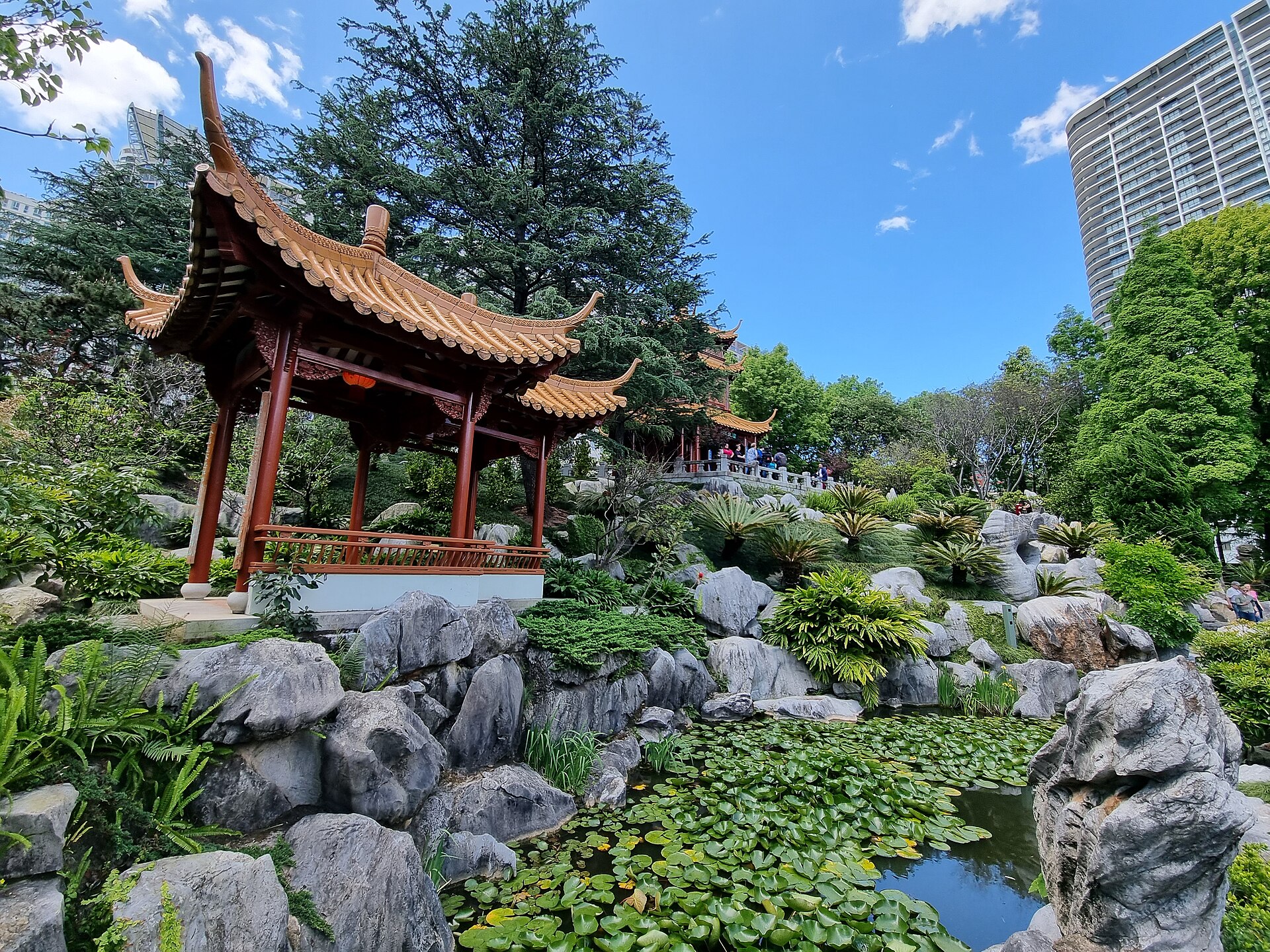
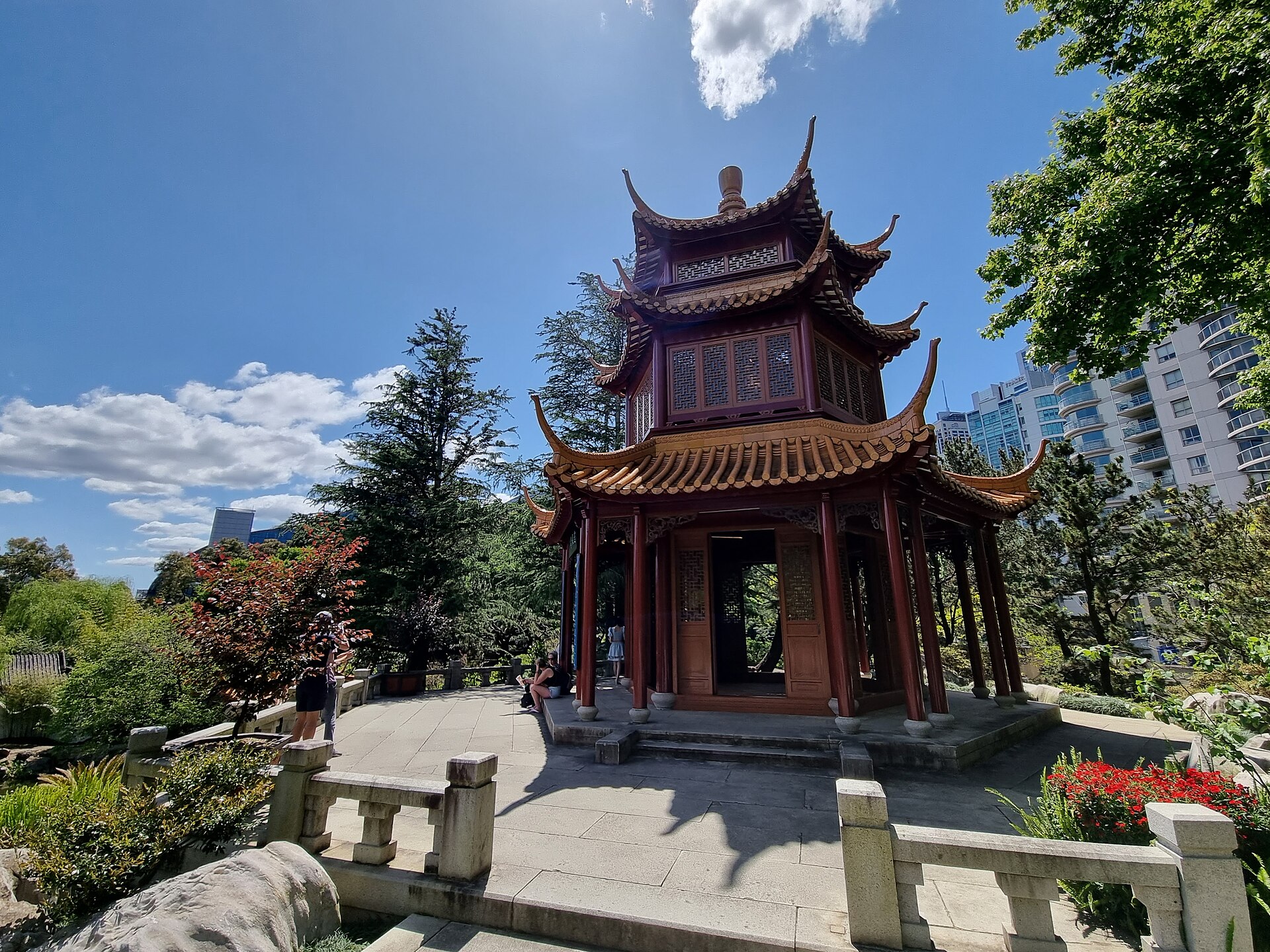
On the far side of the lake, the ground rises into a rockery of grey stone, with paths and steps climbing through it and a waterfall tumbling down towards the lake. The Rock Forest, a cluster of tall, eroded rocks, is here, and so are some of the garden’s most photogenic corners. At the top, the Clear View Pavilion is the highest point in the garden, with views across the lake and pavilions. The upper garden involves steps and uneven rocky paths, so it’s the part to skip if you’re pushing a pram or a wheelchair.
The koi and the water dragons
The lake is full of koi, big orange, white and gold carp that crowd towards anyone standing on a bridge. The fish are fed at 11:30am every day, unless the lake water drops below 10°C, and it’s a good thing to time your visit around if you have children with you. The garden’s other residents are Australian water dragons, large lizards that bask on the rocks and paths and are remarkably unbothered by people. They’re harmless, but give them space and don’t try to feed them.
Gateways, walls and details
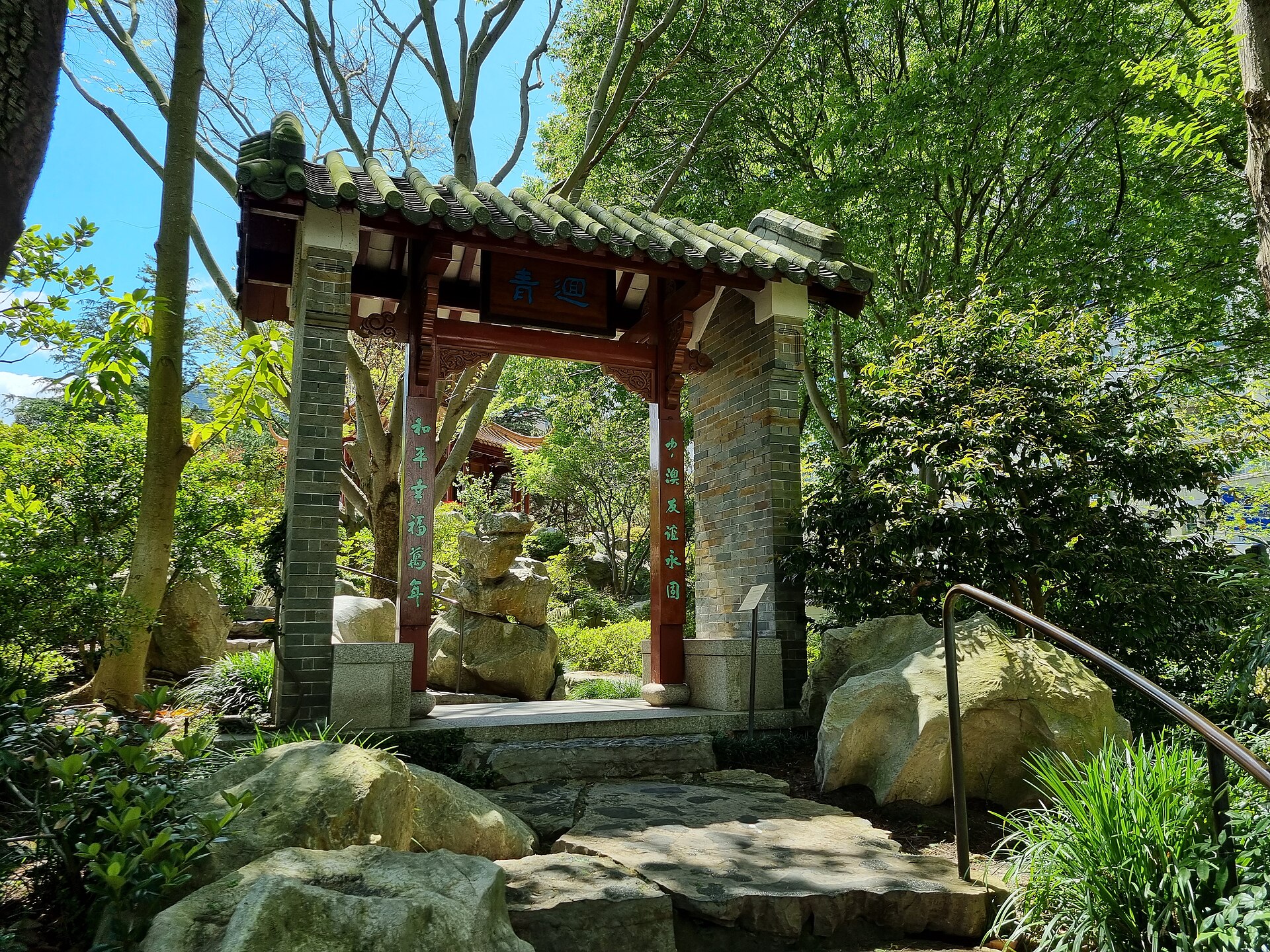
Once you’ve seen the main sights, go back and look at the details: the carved timber of the pavilions, the patterned windows set into walls, the pebble mosaics underfoot, the calligraphy on the gateways and the way each doorway frames a scene. This is where the garden really rewards patience. Many visitors rush the main loop in 20 minutes; the ones who stay an hour see twice as much.
The teahouse
Inside the garden, One Dining is a teahouse-style restaurant serving traditional Chinese dishes with a modern twist, along with artisanal teas and a wine list. A pot of tea overlooking the lake is a good way to slow the visit down, and it gives you time to watch the garden change as the light moves. Check its hours and whether you’ll need a garden ticket before you plan a meal around it. For a cheaper lunch, Chinatown is a five-minute walk away; our Chinatown food guide has the best places.
Tours and activities
- Guided tours run daily, and they’re the easiest way to learn the meaning behind the layout, the plants and the names. Ask at the entrance for the day’s times.
- Fish feeding is at 11:30am daily, weather permitting.
- The Emperor’s Quest is a free daily activity for children, a trail that turns the visit into a game.
- Movement and meditation classes are held on Tuesdays at noon.
- Sunday Sounds brings live music to the garden on selected Sundays.
What’s on through the year
Lunar New Year falls on Saturday 6 February in 2027. Darling Harbour and Chinatown are the centre of Sydney’s celebrations, with lion dances, lanterns and food, and the garden usually runs its own program; check the Darling Harbour website for the year’s events, and see our guide to Sydney in February for the rest of the month. The Mid-Autumn Festival, the moon festival of lanterns and mooncakes, falls in September or early October, and the garden has also marked the winter solstice with events in June. None of these is guaranteed every year, so check before you go.
The garden changes with the seasons, too. Spring and summer bring the fullest greenery and the water lilies at their best, and winter has a spare beauty of its own. It opens at 10am daily, and an early visit in any season is a good way to see it in calm.
When to visit
- Mornings, straight after the 10am opening, are a good time for photos, with the low light on the water.
- Just after rain is lovely: the rocks darken and the colours deepen.
- In summer, come early. The garden is sheltered, and by mid-afternoon it can be hot and still.
- Around Lunar New Year, expect atmosphere, with celebrations across Darling Harbour and Chinatown.
Photography tips
- Come at opening time for still water. On a calm morning the lake mirrors the pavilions almost perfectly, and by lunchtime the breeze and the crowds have usually broken the reflections up.
- Use the frames the designers left you. Doorways, windows and gaps in walls were placed to compose a view, and they do most of the work for you.
- Shoot the eaves against the sky. The upswept roof corners of the pavilions look best from below, against a clear blue sky.
- Decide what to do with the towers. You can hide them with careful angles, or make them part of the picture. The contrast between a timber pavilion and a glass tower is a very Sydney shot.
- Be considerate. Paths and bridges are narrow, so don’t block them for long, and give the water dragons room.
Visiting with children
The Chinese Garden is better with kids than you might think. The fish feeding, the water dragons, the bridges, the stepping stones and the Emperor’s Quest trail will keep most children busy for an hour, and the family ticket makes it cheap. The lower garden works with a pram; the upper garden, with its steps and rocks, is for walking. Right outside the gate, Tumbalong Park has one of the best free playgrounds in the city centre, with water play in the warmer months, so a visit to the garden can end with half an hour of running around. Our guides to the best playgrounds in Sydney and Sydney with kids have more ideas.
Accessibility
The paths and pavilions of the lower garden, around the lake, are accessible for wheelchairs, prams and buggies. The upper part of the garden, including the rockery and the Clear View Pavilion, has steps and rocky paths that make it difficult to reach. You can still see a great deal from the lower paths, including most of the lake and the main pavilions.
Getting there
- Light rail: the L1 Dulwich Hill line stops at Paddy’s Markets and Exhibition Centre, both close to the gate. On George Street, the L2 and L3 lines stop at Chinatown, a longer walk away; the Trip Planner shows the route from where you are.
- Train: Town Hall and Central stations are both within walking distance; the Darling Harbour website has directions from each.
- On foot: the garden is at the southern end of Darling Harbour, so you can walk down from Pyrmont Bridge, past the harbour’s restaurants and attractions.
- Driving: the nearest paid parking is at ICC Sydney. City parking is expensive, and public transport is easier.
Pay for public transport with a contactless card or an Opal card; our guide to getting around Sydney explains how it works.
What’s nearby
The garden sits at the quiet end of Darling Harbour, and it combines easily with the rest of the precinct. Across Harbour Street, Chinatown and Paddy’s Markets (open Wednesday to Sunday) are five minutes away. To the north, the harbour itself has SEA LIFE Sydney Aquarium, the Maritime Museum and a long line of waterfront restaurants; our guide to Darling Harbour attractions covers the lot. To the west, the new Sydney Fish Market on Blackwattle Bay, which opened in January 2026, is about 400 metres from the Wentworth Park light rail stop; our Sydney Fish Market guide explains what’s changed.
If you’re working through the city’s landmarks, the Queen Victoria Building is to the north-east, St Mary’s Cathedral is on the far side of Hyde Park, and Sydney Observatory sits on its hill above The Rocks. A route planner will give you walking times, and the Observatory’s session times are worth checking before you plan an evening there. If you’re staying in the area, our Darling Harbour hotels guide compares the options.
Is the Chinese Garden of Friendship worth it?
Yes, for what it is. A$12 buys you an hour of calm in one of the busiest parts of the city, in a garden that’s beautifully kept and genuinely interesting once you know how to read it. It’s a good choice on a hot day, a good choice with children, and one of the few paid attractions in Darling Harbour that doesn’t feel like a tourist trap.
Manage your expectations, though. It’s compact, the city is always visible over the wall, and you’ll hear it, too. If you’ve visited the great gardens of Suzhou or Shanghai, this is a charming miniature rather than a rival. And if you want a free garden, the Royal Botanic Garden is bigger and costs nothing, though it offers a very different experience. For more ideas for a slower day, see our free things to do in Sydney.
Chinese Garden of Friendship FAQ
How much does the Chinese Garden of Friendship cost?
In 2026, adult tickets cost A$12, children under 12 A$8, Australian concession, student and senior cardholders A$8, and a family ticket for two adults and three children A$30. Children under 5 go free.
What are the opening hours?
The garden is open daily from 10am to 5pm, with last entry shortly before closing. It’s closed on Good Friday and Christmas Day.
Do I need to book Chinese Garden tickets in advance?
No. Adult, child and family tickets can be bought online, but buying at the gate is fine. Concession and senior tickets can only be bought on site with proof of eligibility.
How long should I spend at the Chinese Garden of Friendship?
About 45 minutes to an hour, or longer if you stop for tea at the teahouse.
When is fish feeding at the Chinese Garden?
At 11:30am every day, unless the lake water temperature drops below 10°C.
Is the Chinese Garden wheelchair accessible?
The lower garden, around the lake, is accessible for wheelchairs and prams. The upper garden has steps and rocky paths.
Where is the entrance?
On Tumbalong Boulevard, at the southern end of Darling Harbour, near the corner of Pier Street and Harbour Street and a short walk from Chinatown.
When was the Chinese Garden of Friendship built?
It opened on 17 January 1988, during Australia’s Bicentenary, as a symbol of friendship between Sydney and its sister city, Guangzhou.
Related Sydney guides
- Sydney landmarks: the city’s icons, one by one.
- Darling Harbour attractions: everything else at this end of the city.
- Chinatown food guide: lunch five minutes from the gate.
- Queen Victoria Building: a short walk north-east.
- Royal Botanic Garden: the big, free garden by the harbour.
- Best playgrounds in Sydney: including Tumbalong Park, next door.
- Sydney Observatory: an evening under the stars above The Rocks.
Photo Credits
The lake and pavilions of the Chinese Garden of Friendship: 2022-10-15 Chinese Garden of Friendship, Sydney 1 by Maksym Kozlenko, CC BY-SA 4.0, via Wikimedia Commons.
A pavilion above the rockery: 2022-10-15 Chinese Garden of Friendship, Sydney 3 by Maksym Kozlenko, CC BY-SA 4.0, via Wikimedia Commons.
The lake with Darling Harbour’s buildings behind: 2022-10-15 Chinese Garden of Friendship, Sydney 4 by Maksym Kozlenko, CC BY-SA 4.0, via Wikimedia Commons.
A tiered pavilion: 2022-10-15 Chinese Garden of Friendship, Sydney 5 by Maksym Kozlenko, CC BY-SA 4.0, via Wikimedia Commons.
A gateway with calligraphy: 2022-10-15 Chinese Garden of Friendship, Sydney 6 by Maksym Kozlenko, CC BY-SA 4.0, via Wikimedia Commons.