Queen Victoria Building: Shopping, History and the Clocks
The QVB beyond the shops: the 1898 building and its 1986 rescue, when the Royal Clock performs, the Great Australian Clock, Queen Victoria's statue, high tea, the Christmas tree and the 2026 opening hours.
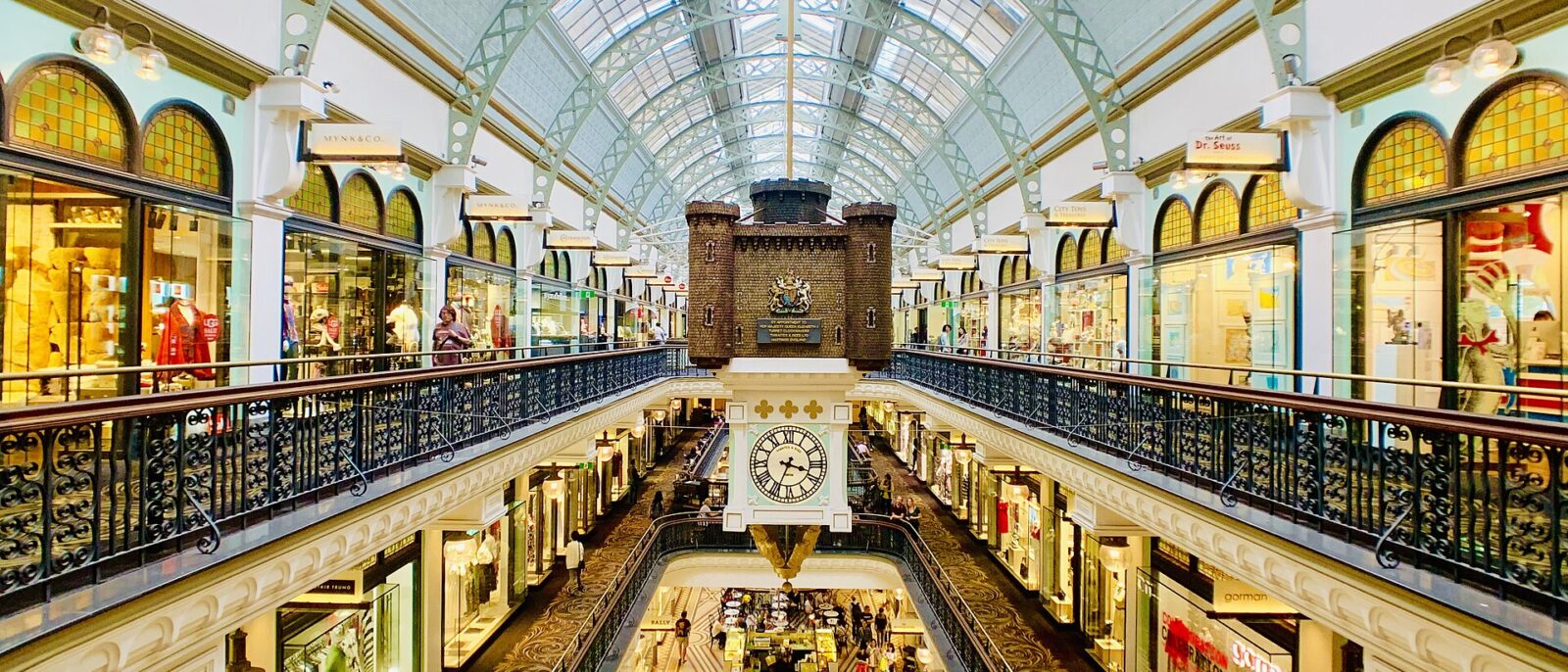
Look up to the gallery at one end of the building and you’ll find the Royal Clock, where trumpets sound, tiny trumpeters pop out of the turrets, and a procession of English kings and queens turns slowly past, ending, rather startlingly, with the execution of Charles I. It’s that sort of building. The Queen Victoria Building, the QVB to every Sydneysider, fills an entire city block of George Street with a Victorian sandstone palace of copper domes, stained glass and mosaic floors, and although it’s full of shops, most visitors come for the building itself.
This guide covers what to see inside and out, from the dome and the two great hanging clocks to Queen Victoria’s statue and the talking dog, the building’s history, including how close it came to being demolished, its 2026 opening hours, high tea in the Tea Room, the famous Christmas tree, how to get there and how long to allow. Hours and prices were checked in October 2026; treat them as the right order of magnitude. For the city’s other icons, see our guide to Sydney’s landmarks.
Queen Victoria Building at a glance
| Detail | Queen Victoria Building |
|---|---|
| Address | 455 George Street, Sydney; the block between George, York, Market and Druitt streets |
| Opening hours | Monday to Wednesday, Friday and Saturday 9am to 6pm; Thursday 9am to 9pm; Sunday 11am to 5pm |
| Entry | Free |
| Built | 1898, designed by the city architect George McRae |
| Restored | Reopened in 1986 after a restoration by the Malaysian company Ipoh |
| Don’t miss | The central dome, the Royal Clock, the Great Australian Clock, Queen Victoria’s statue and Islay the dog |
| High tea | The Tea Room on Level 3, from 10am daily; traditional high tea A$80 per person |
| Nearest station | Town Hall, connected by an underground walkway; the QVB light rail stop is outside on George Street |
| Time needed | A short stop to see the building; longer for shopping or high tea |
| Worth it? | Yes, even if you don’t buy anything |
What to see at the QVB
The building from outside
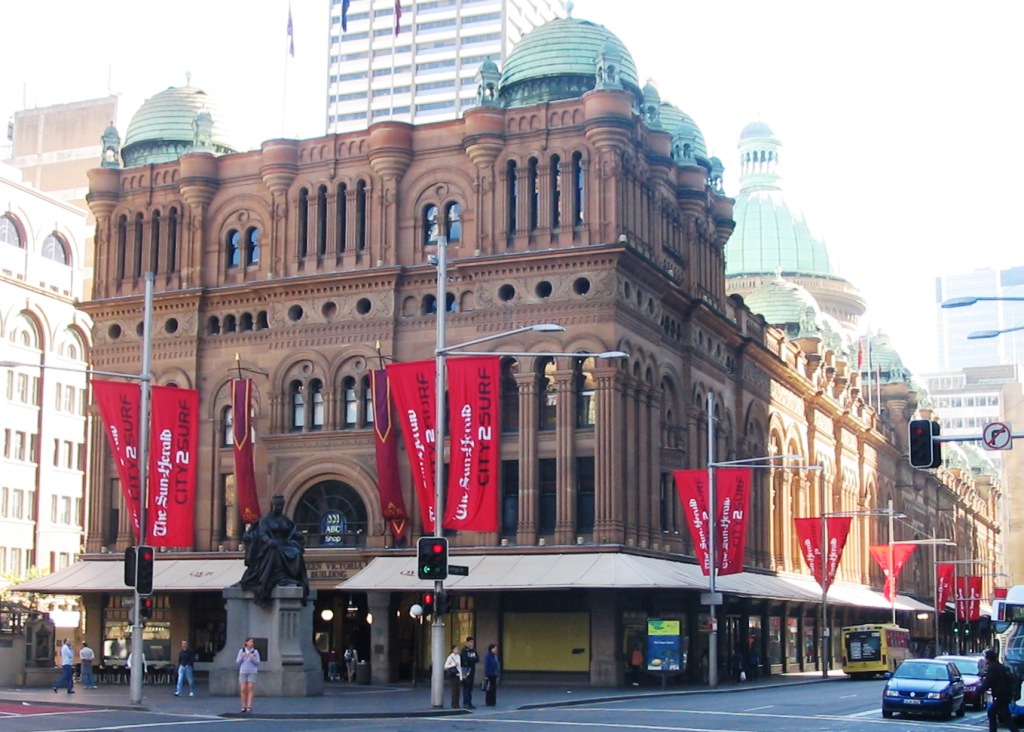
Start outside, because the QVB’s scale is easiest to appreciate from the street. The building runs almost 200 metres along George Street, a long Romanesque arcade of honey-coloured sandstone, round-arched windows and turrets, topped by copper domes that have weathered to green. The biggest dome, over the centre of the building, rises high above the street, and smaller domes and cupolas crown the corners. The best view is from the southern end, near Druitt Street and Sydney Town Hall, where Queen Victoria herself sits on a plinth in front of the entrance.
The central dome
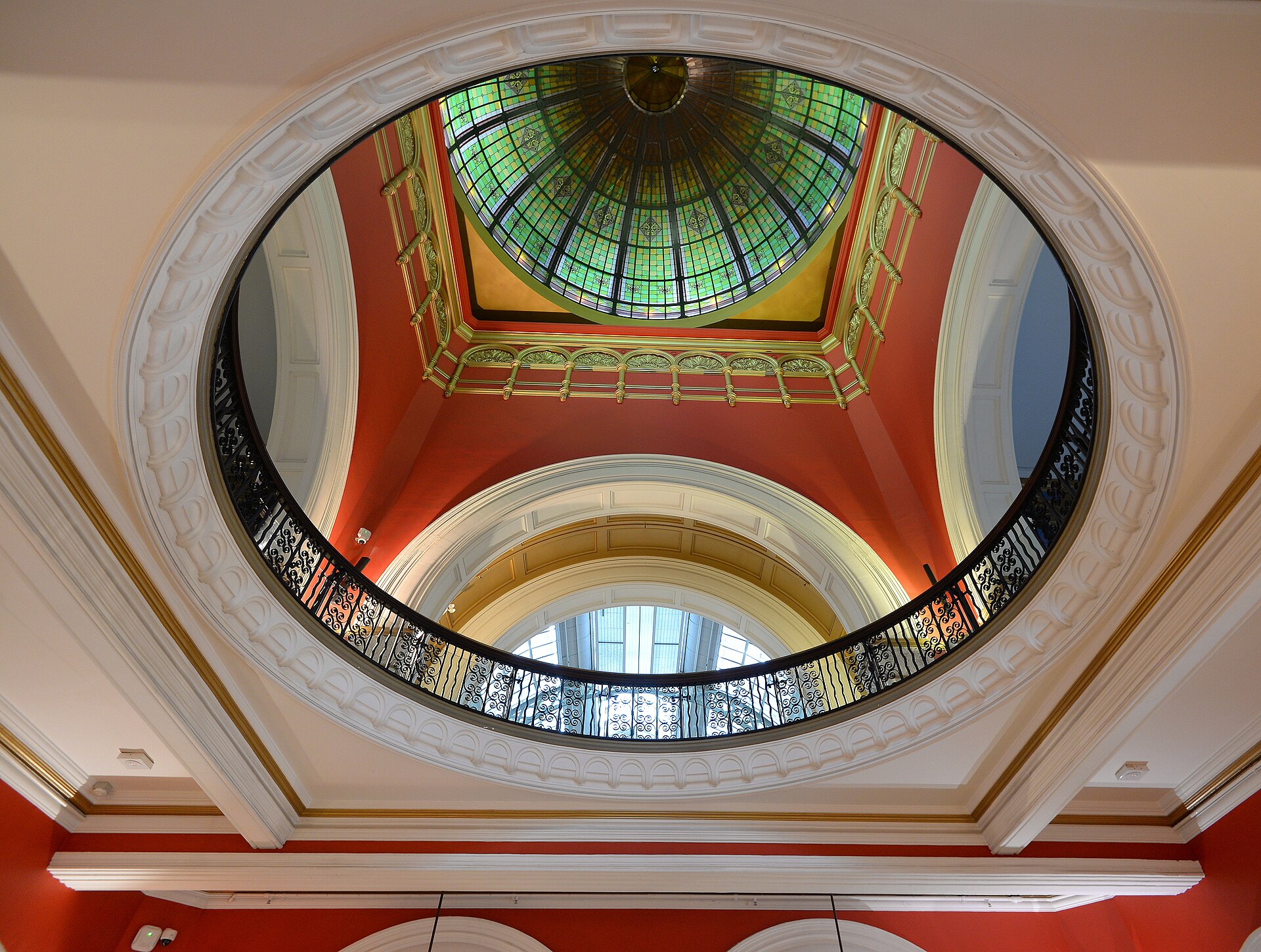
Inside, walk to the middle of the building and look up. The central dome is a glass dome within a copper one, with a ring of coloured glass, deep red walls and ornate plasterwork, framed by a circular balcony of wrought-iron railings on each floor. It’s the building’s showpiece and the most photographed spot inside, and it’s at its best from the upper levels, where you can lean on the railings and look both up into the dome and down through the floors to the mosaic tiles on the ground floor.
The Royal Clock
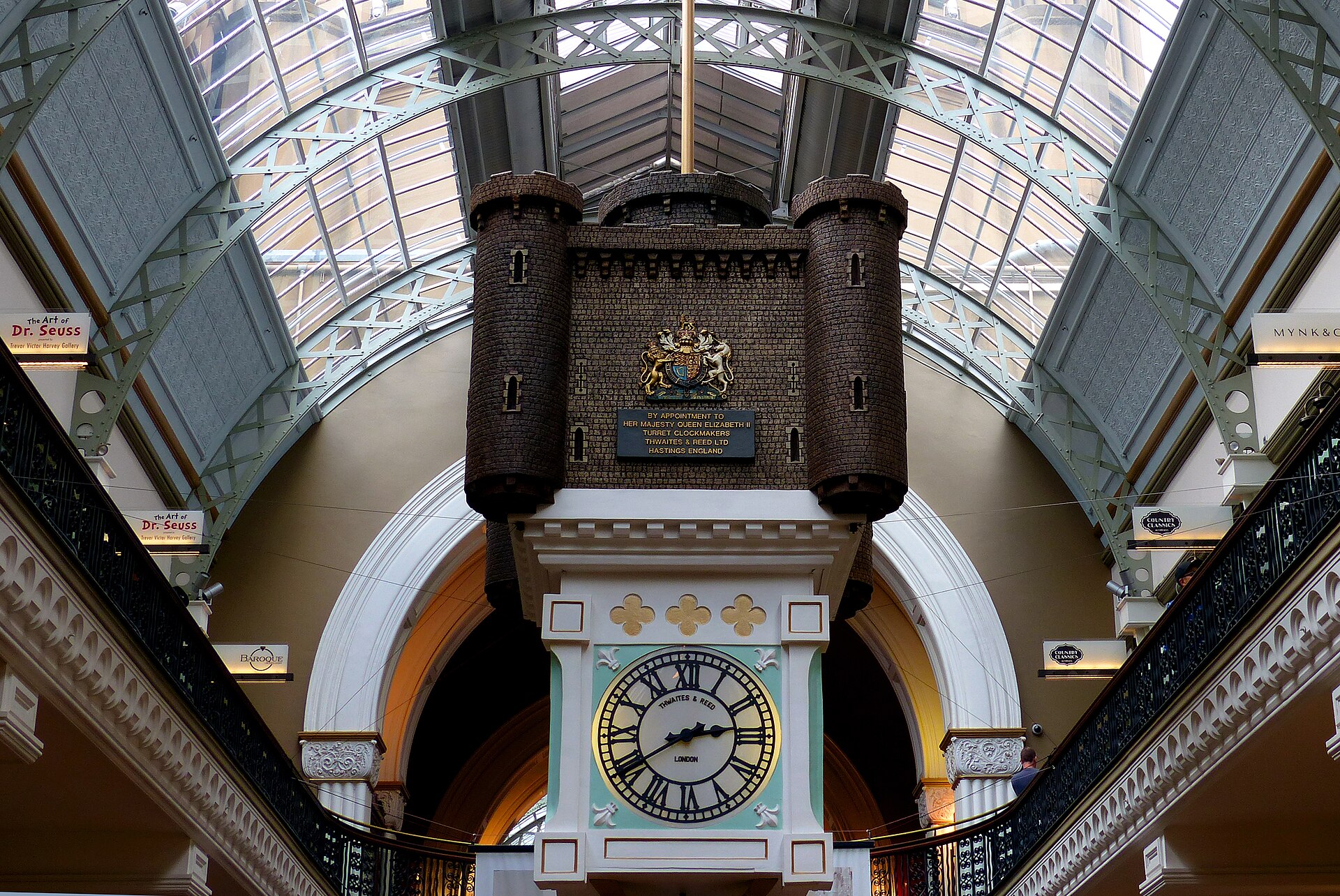
Hanging over the gallery at one end of the building, the Royal Clock looks like a small castle suspended in mid-air, with turrets, a royal coat of arms and a large clock face below. It was designed by Neil Glasser and made by the English clockmakers Thwaites and Reed. Its mechanism brings it to life: a trumpet voluntary plays, miniature trumpeters emerge from the turrets, and a series of scenes from the history of the English monarchy rotates into view, including, memorably, the beheading of Charles I. It’s worth planning your visit around, so check the QVB’s website for the current performance times, and get to the upper gallery a few minutes early for a good view.
The Great Australian Clock
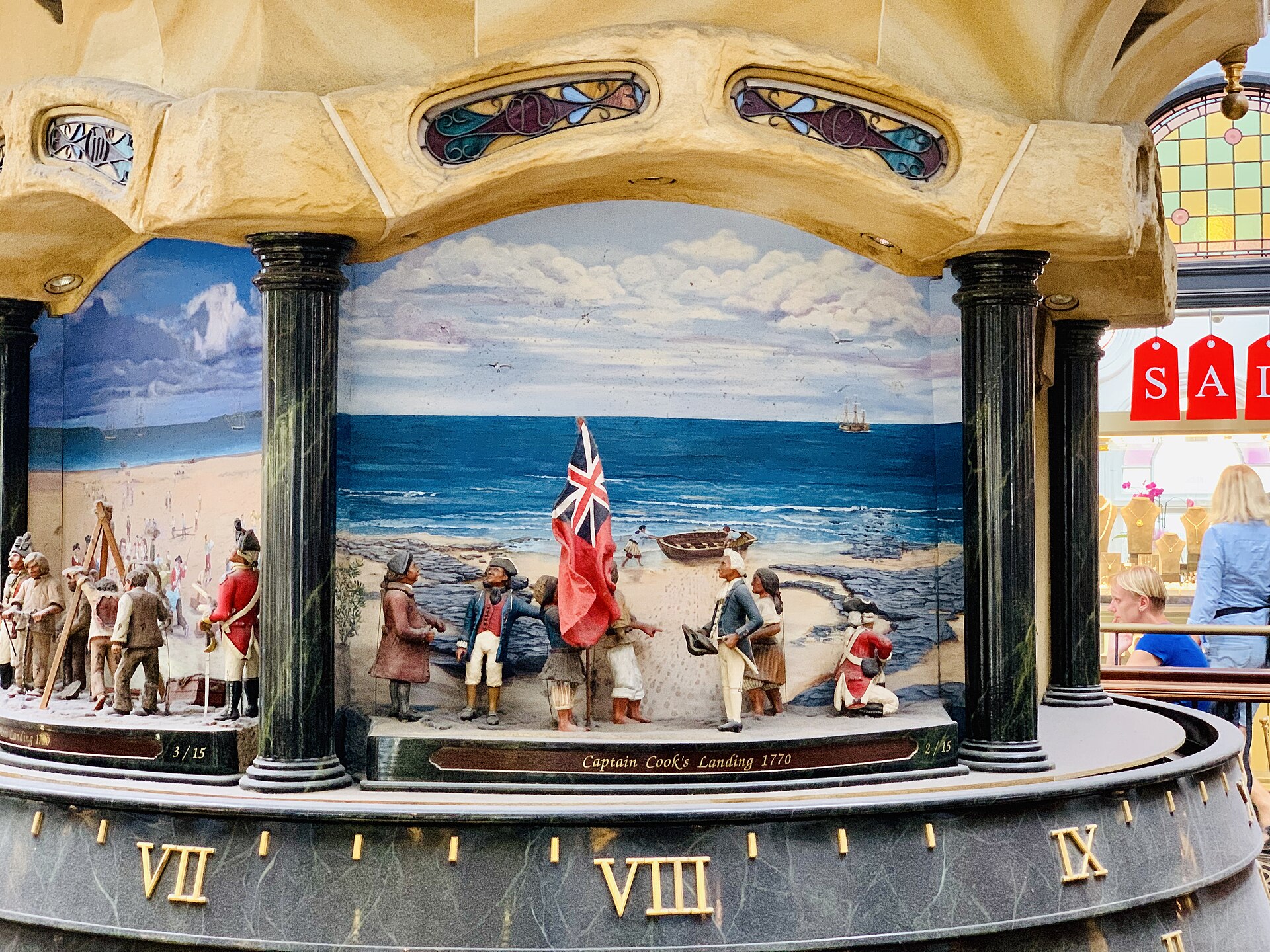
The QVB’s other great clock is the Great Australian Clock, made by the clockmaker Chris Cook over four years. It stands about ten metres tall and weighs four tonnes, and it tells the story of Australia in 33 scenes, from both Aboriginal and European perspectives, from life before 1788 to Captain Cook’s landing and the colonial years that followed. An Aboriginal hunter circles the outside of the clock, marking the passing of time. It rewards a slow walk around, reading the scenes; it’s a surprisingly thoughtful piece of work to find in a shopping centre.
Queen Victoria and Islay the dog
Outside the southern entrance sits a bronze statue of Queen Victoria that has had an unusual life. It originally stood in front of Leinster House in Dublin, the home of the Irish parliament, until it was removed in the late 1940s and put into storage. Decades later, it was shipped to Sydney and unveiled outside the QVB on 20 December 1987. Nearby is a wishing well with a bronze statue of Islay, Queen Victoria’s favourite Cairn terrier, modelled on a sketch the Queen drew. Drop a coin in, and Islay “speaks”. Children love it, and it’s a nice, silly counterpoint to all the grandeur.
Stained glass, floors and details
Much of the QVB’s charm is in the details, so slow down. Look for the stained-glass windows at the ends of the building and in the entrances, the original cast-iron balustrades and staircases, the tiled mosaic floors on the ground level, and the arched glass roof that runs the length of the arcade and fills it with light. The upper levels are quieter than the ground floor and have the best views down through the building.
A short history of the QVB
The QVB was built between 1893 and 1898 on the site of the city’s old markets, as a grand market hall designed by George McRae, the city architect, in a Romanesque Revival style. It was named in honour of Queen Victoria, who was then celebrating her jubilee. In its early years, it housed a market, shops, offices, showrooms and, over time, a range of other uses, and during the 20th century it was altered repeatedly as tastes and needs changed. By the middle of the century, it was run-down and out of fashion.
In 1959, an alderman proposed demolishing it and replacing it with a civic square, with parking and shopping underneath. The plan was never carried out, but the building’s future remained uncertain for years. In 1980, the Malaysian company Ipoh put forward a restoration scheme, and in 1983 the council granted it a 99-year lease. The restored Queen Victoria Building reopened in 1986, and it has been one of the city’s best-loved buildings ever since. Our Sydney architecture tour puts it alongside the city’s other Victorian landmarks.
Opening hours
| Day | Hours |
|---|---|
| Monday to Wednesday | 9am to 6pm |
| Thursday | 9am to 9pm (late-night shopping) |
| Friday and Saturday | 9am to 6pm |
| Sunday | 11am to 5pm |
Shops on Levels 1 and 2 open from 10am from Monday to Saturday, so an early-morning visit is quieter but some shops won’t yet be open. Public holiday hours vary, so check the QVB’s website before you go on a holiday. The building is at its most atmospheric on Thursday evenings, when late-night shopping keeps it busy and lit up, and at its quietest on weekday mornings.
Shopping at the QVB
The QVB has shops over several levels, mostly fashion, jewellery, accessories, homewares and gifts, with a mix of Australian and international brands and a handful of more specialist stores. It’s upmarket rather than cheap, and much of what’s here you’ll find elsewhere in the city. The honest verdict: come for the building, not the bargains. If you do want to shop, the QVB is the start of Sydney’s main shopping strip, with the Galeries across the road, the Strand Arcade, another beautiful Victorian arcade from 1892, a short walk north, and Pitt Street Mall beyond it. Cafés and quick lunch spots are spread through the building, with more food options on the lower ground level near the walkway to Town Hall station.
High tea at the Tea Room
On Level 3, the Tea Room serves high tea in a grand, high-ceilinged room with chandeliers, a European-style setting that suits the building perfectly. High tea is served from 10am daily, and the traditional high tea costs A$80 per person, with finger sandwiches, sweet and savoury pastries, a scone with jam and cream, and tea or coffee. It’s a special-occasion price, and it’s popular for birthdays and celebrations, so book ahead. If you’d like the atmosphere without the full spread, a coffee in one of the building’s cafés and a walk around the upper galleries costs a lot less.
The QVB at Christmas
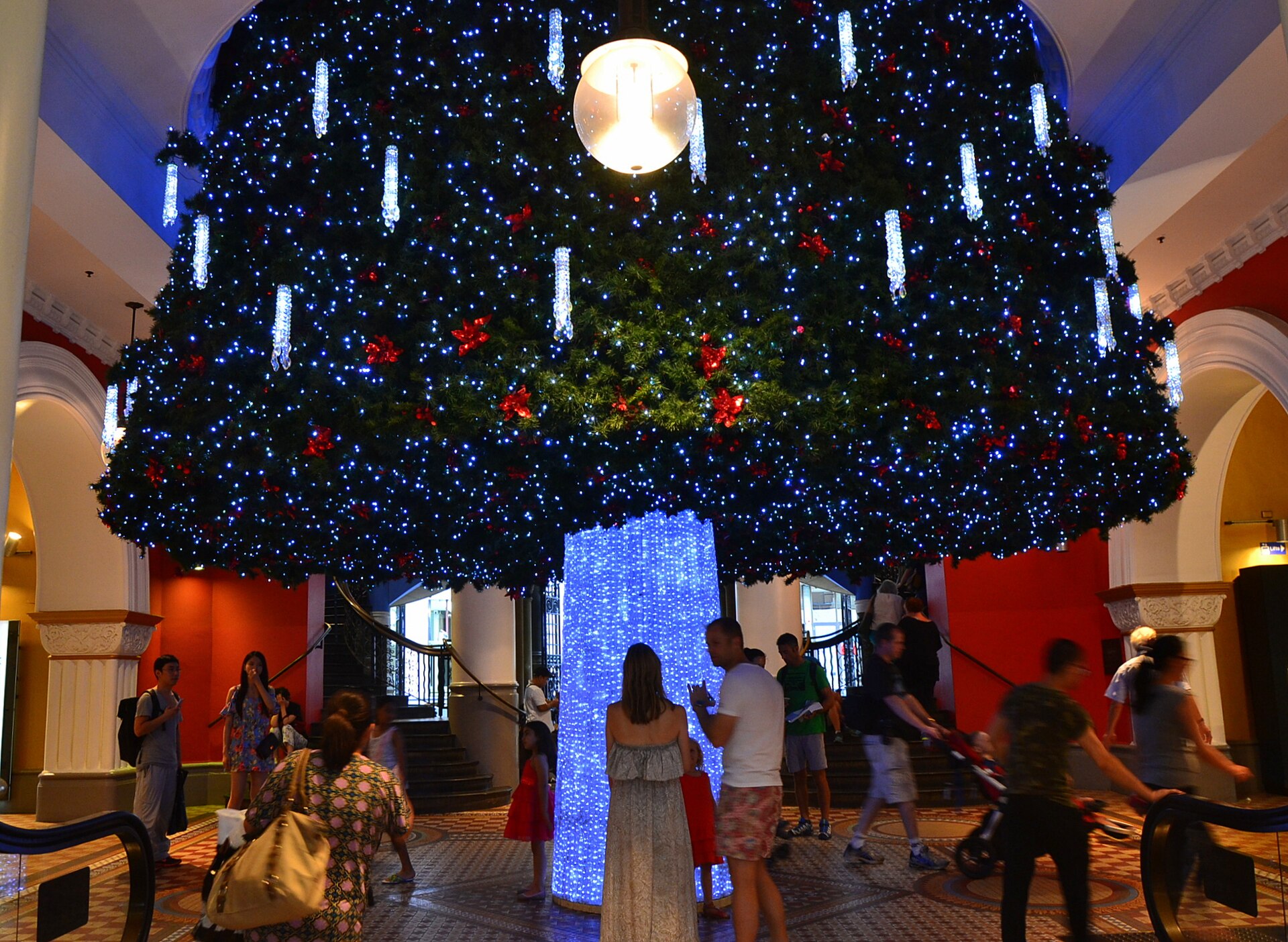
From November, the QVB puts up one of Sydney’s most famous Christmas trees, a giant tree that rises through three levels of the central atrium beneath the dome. In recent years it has taken inspiration from Australian plants and First Nations artists; the 2025 tree was inspired by the Wollemi pine and created with artists from the Boomalli Aboriginal Artists Co-operative. It’s a lovely sight in the evenings, when the building is lit up and busy with Christmas shoppers. Our guides to Christmas in Sydney and Sydney in December cover the rest of the season.
Getting to the QVB
- Train: Town Hall station is directly connected to the QVB by an underground walkway, so you can arrive without going outside, which is handy on a hot or wet day. Our train network guide covers the lines.
- Light rail: the QVB stop on George Street, on the line between Circular Quay and Central, is right outside.
- On foot: the QVB is on George Street, so it’s a walk from Circular Quay, Hyde Park, Darling Harbour and Chinatown; a walking route planner will give you the time from where you’re staying.
- Bus: many city buses run along York Street and George Street, stopping close by.
Pay for public transport with a contactless card or an Opal card; our guide to getting around Sydney has the details.
Nearby
The QVB is at the heart of the city centre, and several other landmarks are within a few minutes’ walk. Sydney Town Hall, across Druitt Street, is a grand Victorian building with one of the world’s great concert organs, and St Andrew’s Cathedral, beside it, is the country’s oldest cathedral. A short walk east, the Sydney Tower Eye has the highest views in the city; our Tower Eye guide covers tickets. West of the QVB, it’s a ten-minute walk down to Darling Harbour, and south to Chinatown and Haymarket, where our Chinatown food guide has the best places for lunch. North along George Street are Martin Place, The Rocks and Circular Quay, where you can start a walk across the Harbour Bridge; our Harbour Bridge walk guide explains how.
A walk from the QVB to the harbour
The QVB makes a good starting point for an hour’s walk through the city’s Victorian heart to the harbour. Leave by the northern end and continue north along George Street, where the light rail glides past some of the city’s finest old commercial buildings. Detour right into Martin Place to see the sandstone General Post Office and its clock tower, then carry on down George Street into The Rocks, one of the city’s earliest colonial precincts, with its sandstone warehouses, laneways and pubs. Finish at Circular Quay, with the Opera House on one side and the Harbour Bridge on the other. Alternatively, head east from the QVB along Market Street to Hyde Park, and walk through the park to St Mary’s Cathedral and the Hyde Park Barracks. Our guides to The Rocks and Hyde Park Barracks cover both ends.
How to plan your visit
- Allow time to see the building properly, and longer if you want to shop or have high tea.
- Check the Royal Clock’s performance times on the QVB’s website, so you can watch it perform.
- Go upstairs. The upper galleries have the best views of the dome, the clocks and the arcade, and they’re quieter.
- Visit on a weekday morning for the fewest people, or on a Thursday evening for the late-night atmosphere.
- Combine it with Town Hall, the Tower Eye and Hyde Park, or with Darling Harbour and Chinatown.
- Use it as a rainy-day stop: it’s under cover and connected to the station. Our rainy day activities guide has more ideas.
The QVB with children
Children tend to enjoy the QVB more than parents expect, as long as you skip most of the shops. Islay, the talking dog in the wishing well outside, is an easy win, the Royal Clock’s performance is an event if you get there early enough for a good view, and the tiny figures in the Great Australian Clock’s scenes can keep older children busy for a while. At Christmas, the giant tree under the dome is the highlight. The building has lifts as well as stairs and escalators, so a pram is manageable, and the underground link to Town Hall station keeps you out of the weather.
Photography tips
- From the upper galleries, shoot down through the circular balconies under the central dome, or up into the dome itself.
- From either end of the upper levels, the long view down the arcade, with the glass roof and the hanging clocks, captures the scale of the building.
- From the street, the southern end with Queen Victoria’s statue is the classic exterior view, and the domes look best in late-afternoon light.
- Early on a weekday you’ll have the galleries largely to yourself; by lunchtime they’re busy.
Is the Queen Victoria Building worth visiting?
Yes, it’s one of the best free things to see in central Sydney. The architecture is superb, the dome and the clocks are genuinely delightful, and it takes less than an hour. You don’t need to spend a cent to enjoy it.
Don’t come for the shopping alone. The shops are good but mostly upmarket, and you can find much of the same elsewhere in the city. And unless it’s a special occasion, the high tea is a treat rather than a necessity. For more free sightseeing, see our free things to do guide.
Queen Victoria Building FAQ
What are the QVB’s opening hours?
Monday to Wednesday, Friday and Saturday from 9am to 6pm, Thursday from 9am to 9pm and Sunday from 11am to 5pm. Shops on Levels 1 and 2 open at 10am from Monday to Saturday.
Is it free to visit the Queen Victoria Building?
Yes. There’s no charge to enter or look around; you only pay for what you buy.
When does the Royal Clock perform?
The clock’s mechanism brings out trumpeters and a rotating display of scenes from English royal history. Check the QVB’s website for the current performance times.
What is the Great Australian Clock?
A four-tonne, ten-metre clock made by Chris Cook, which tells the story of Australia in 33 scenes from Aboriginal and European perspectives.
When was the QVB built?
It was completed in 1898, designed by the city architect George McRae. After years of decline and a proposal to demolish it in 1959, it was restored and reopened in 1986.
How much is high tea at the QVB?
The traditional high tea at the Tea Room on Level 3 costs A$80 per person. It’s served from 10am daily, and booking is recommended.
Which station is closest to the QVB?
Town Hall, which is connected to the building by an underground walkway. The QVB light rail stop is directly outside on George Street.
When is the QVB Christmas tree up?
From November until after Christmas. It rises through three levels of the atrium under the central dome.
Ten minutes east of the QVB, across Hyde Park, is St Mary’s, the city’s Catholic cathedral, and the two buildings make a good pair: Victorian commerce on one side of the park, Victorian Gothic on the other. Our guide to St Mary’s Cathedral covers opening hours, Mass times and the free Sunday tour.
Related Sydney guides
- Sydney landmarks: the city’s icons explained.
- Sydney architecture tour: the QVB and the city’s other great buildings.
- Sydney Harbour guide: how to see the harbour properly.
- Sydney Tower Eye: the view from above, a short walk away.
- Christmas in Sydney: the QVB tree and the rest of the season.
- Chinatown food guide: lunch a ten-minute walk south.
- Free things to do in Sydney: the QVB and more.
Photo Credits
The QVB arcade and the Royal Clock: Interior of Queen Victoria Building with Royal Clock, Sydney 02 by Kgbo, CC BY-SA 4.0, via Wikimedia Commons.
The southern end of the QVB and Queen Victoria’s statue: Southern end of the Queen Victoria Building, Sydney, July 2005 by Skyring, CC BY-SA 3.0, via Wikimedia Commons.
The central dome: (1)QVB-19a by Sardaka, CC BY-SA 4.0, via Wikimedia Commons.
The Royal Clock: The Royal Clock.QVB Sydney. (21202018312) by Bernard Spragg, CC0, via Wikimedia Commons.
The Great Australian Clock: Great Australian Clock at the Queen Victoria Building, Sydney 03 by Kgbo, CC BY-SA 4.0, via Wikimedia Commons.
The QVB Christmas tree: (1)Queen Victoria Building Christmas 2013 by Sardaka, CC BY 3.0, via Wikimedia Commons.