Newcastle from Sydney: Beaches, Baths and the Train Up
The train, the light rail and the Bathers Way from Nobbys to Merewether: how to see Newcastle's ocean baths, the Bogey Hole and Fort Scratchley on a day trip or a night away from Sydney.
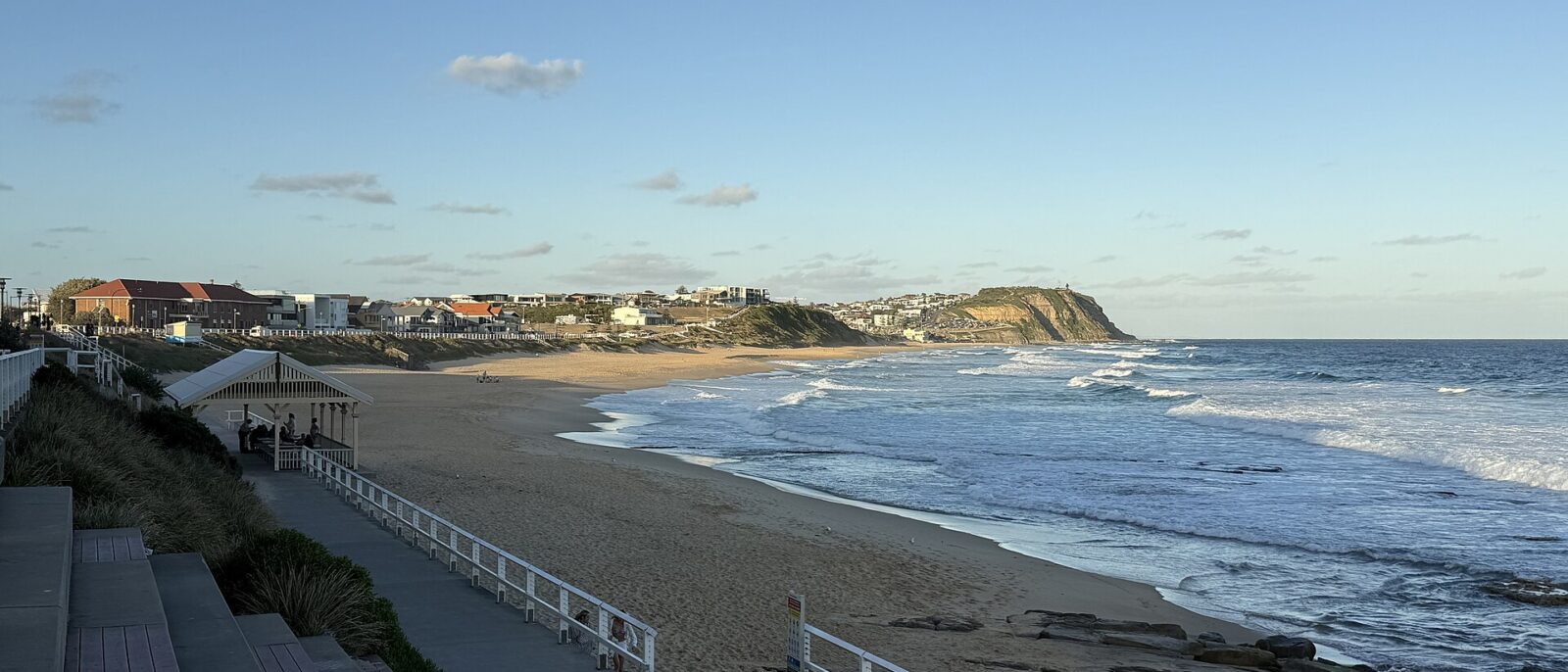
Look out to sea from almost any beach in Newcastle and you’ll start counting them: a dozen or more bulk carriers riding at anchor on the horizon, waiting their turn to come in past Nobbys and load coal. It’s the first sign that this isn’t a smaller Sydney. It’s a working port city with a surf culture bolted on, and that mix is exactly what makes Newcastle from Sydney such a good trip: two and a half hours up the line on an Opal card, then ocean baths, a convict-cut rock pool, a clifftop memorial walk and one of the best stretches of urban coastline in the country.
This guide covers the train and the drive, getting from the station to the beach, the Bathers Way walk from Nobbys to Merewether, the ocean baths, Fort Scratchley, the best of the city itself, and whether it works as a day trip or needs a night. Prices and hours were checked in September 2026; treat prices as the right order of magnitude and confirm anything time-sensitive before you travel.
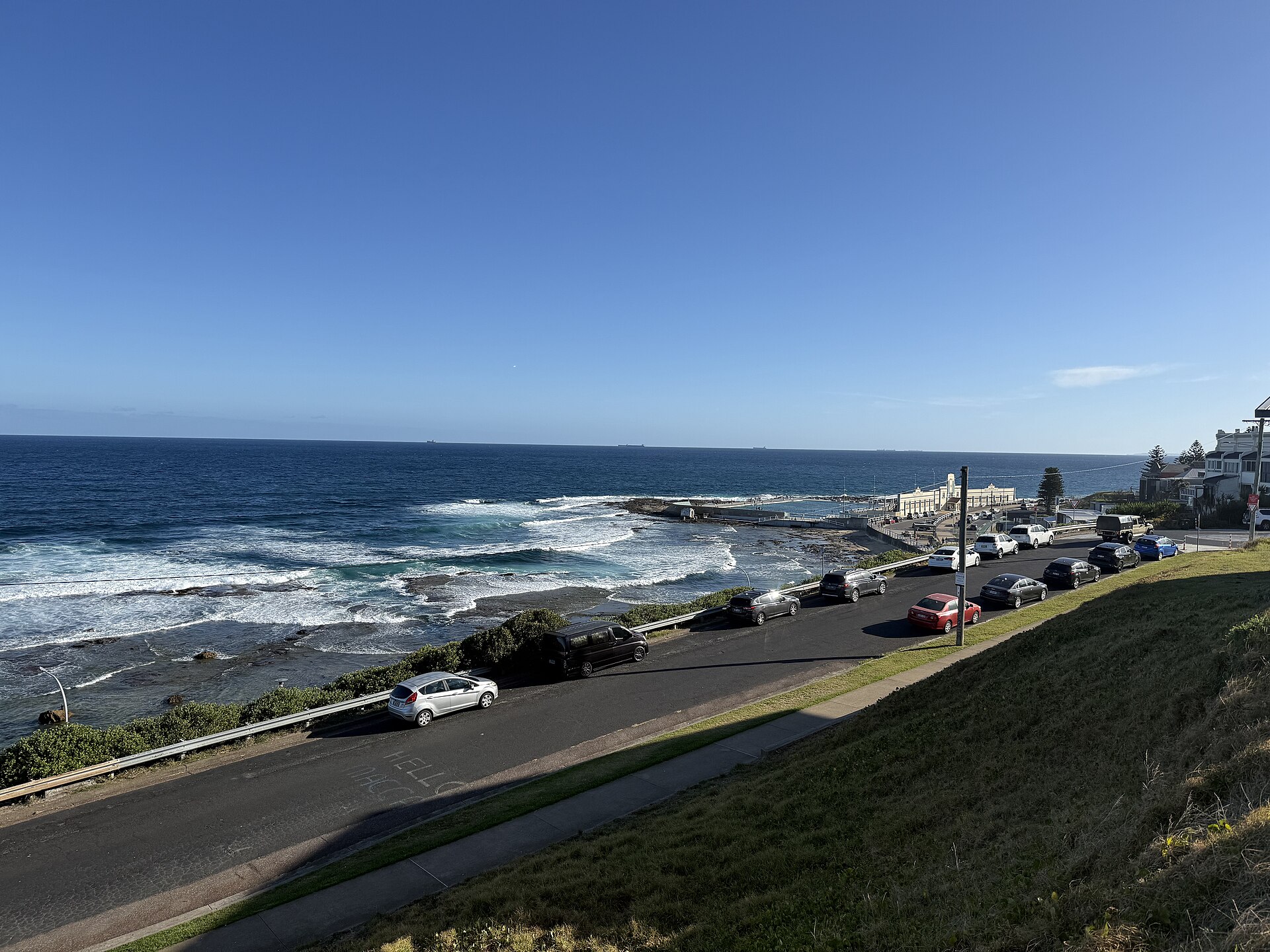
Newcastle at a glance
| Detail | What to know |
|---|---|
| Distance from Sydney | About 160 km north |
| Train | Central Coast and Newcastle Line, about 2.5 hours from Central to Newcastle Interchange, on Opal |
| Driving time | About 2 hours via the M1 Pacific Motorway |
| Station to beach | Light rail, six stops, from Newcastle Interchange to Newcastle Beach |
| Headline sights | Bathers Way coastal walk, Newcastle and Merewether ocean baths, the Bogey Hole, Memorial Walk, Nobbys, Fort Scratchley |
| Day trip or overnight? | Doable in a day by train, but it’s five hours of travel. One night makes it far better |
| Best for | Beaches and ocean pools, coastal walking, a relaxed city with good food and none of Sydney’s prices |
| Combine with | Port Stephens (an hour north) or the Hunter Valley (about an hour inland) |
What it costs
| Item | Price |
|---|---|
| Train, Central to Newcastle | Top Opal distance fare, under A$10 each way at peak, less off-peak; daily caps apply |
| Light rail | A$2.20 adult on Opal, or 20 cents if you tap on within 60 minutes of getting off the train |
| Ocean baths, Bogey Hole, Bathers Way, Memorial Walk | Free |
| Fort Scratchley | Free entry; guided tunnel tours are paid and need booking |
| Newcastle Museum | Free general entry |
| Stockton ferry | Standard Opal ferry fare |
Newcastle is one of the cheapest good days out from Sydney. Almost everything worth doing on the coast is free, and the train fare is capped. Your main costs are lunch, which is noticeably cheaper than the equivalent in Sydney, and a tunnel tour if you want one.
Understanding Newcastle
Newcastle is the second-largest city in NSW, sitting at the mouth of the Hunter River on Awabakal and Worimi Country. It was founded as a convict settlement in 1804, grew rich on coal, and became Australia’s steel city once BHP opened its steelworks here in 1915. It has been through hard times since: the 1989 earthquake killed 13 people and damaged much of the old city, and the steelworks closed in 1999. What’s emerged over the last two decades is a relaxed, creative, slightly scruffy city that locals are fiercely proud of and that Sydneysiders keep moving to. The port hasn’t gone anywhere, though. Newcastle is still one of the biggest coal-export ports in the world, and the ships on the horizon are a permanent fixture.
For a visitor, the city breaks down into a handful of areas:
- The East End, on the narrow peninsula between the harbour and the ocean, with Nobbys, Fort Scratchley, Newcastle Beach and the ocean baths. This is where you’ll spend most of your time.
- Honeysuckle, the old railway yards and wharves along the harbour, now restaurants, apartments and the Newcastle Museum.
- Cooks Hill and Darby Street, just inland, the city’s best strip of cafés, bars and small shops.
- Hamilton, west of the centre, where Beaumont Street is lined with Italian restaurants from the post-war migrant era.
- Merewether and Bar Beach, the southern beach suburbs at the far end of the coastal walk.
- Stockton, across the harbour mouth, a five-minute ferry ride away and the start of the huge dune system that runs north towards Port Stephens.
Getting from Sydney to Newcastle
By train
The Central Coast and Newcastle Line runs from Central through Strathfield and Hornsby, down through the bush to the Hawkesbury River, across the Central Coast past Gosford and Lake Macquarie, and into Newcastle Interchange at Wickham. The trip takes about two and a half hours, and services run roughly every half-hour to hour for most of the day. It’s all Opal: tap on at Central and off at Newcastle, paying the same top distance fare as a trip to the Blue Mountains, which is A$10.66 each way at peak and A$7.46 off-peak for an adult. The daily cap covers the return. Our Opal card guide explains the caps and off-peak discounts.
Get a window seat. North of Hornsby the line skirts the edge of Ku-ring-gai Chase National Park, drops down to the Hawkesbury River, and then runs along the shores of Brisbane Water, and it’s one of the prettiest suburban train rides in Australia. Newer Mariyung intercity trains are gradually taking over on the line, with more comfortable seating than the old fleet. The Sydney train network guide shows how the line fits in with the rest of the system.
One thing that confuses first-time visitors: the heavy-rail line no longer runs into the old city centre. It was cut back in 2014, and the terminus is now Newcastle Interchange at Wickham, a couple of kilometres from the beach. From there, the Newcastle Light Rail runs six stops through Honeysuckle, Civic, Crown Street and Queens Wharf to Newcastle Beach. The fare is A$2.20 on an adult Opal card, but if you tap on within 60 minutes of tapping off the train, the Opal transfer discount cuts that to 20 cents.
Driving
Take the M1 Pacific Motorway north over the Hawkesbury and up past the Central Coast, then follow the signs into Newcastle. It’s about two hours from the CBD without heavy traffic. Tolls depend on how you leave the city; routes via NorthConnex or the M2 are tolled, while the motorway north of Wahroonga is free. Friday afternoons northbound and Sunday afternoons southbound are the times to avoid, particularly in summer and on long weekends. Parking in the East End is metered and fills up on sunny weekends, so if you can, park once and walk or take the light rail. Our driving in Sydney guide covers the tolls and hire-car rules.
If you’re driving, the Central Coast is right on the way. Terrigal or The Entrance make a good lunch stop on the way up, although not on a day when you also want to see Newcastle properly.
Tours
Day tours that go only to Newcastle are rare. Most operators fold it into a Port Stephens or Hunter Valley tour, which usually means a quick stop at Nobbys or the Memorial Walk. Since the train takes you almost to the beach for the price of an Opal fare, a tour makes sense only if Newcastle is a side dish rather than the main meal.
The Bathers Way: Nobbys to Merewether
The best thing to do in Newcastle is walk the Bathers Way, a coastal path of about six kilometres from Nobbys Beach in the north to Merewether in the south. It links every beach, ocean bath and headland on the city’s coast and has cafés at regular intervals. Allow two to three hours at a strolling pace, longer if you swim, and you will want to swim. Here’s what you pass, heading south.
Nobbys Beach
Nobbys is the sheltered beach right under the headland at the harbour mouth, patrolled in season and often calmer than the beaches further south. From here you can also walk out along the breakwall to Nobbys Head. More on that below.
Newcastle Beach and the Newcastle Ocean Baths
Newcastle Beach is the city beach, a short walk from the light rail terminus, with a surf club and the Newcastle Ocean Baths at its northern end. The baths are a big, shallow, tide-fed pool behind a cream-and-green pavilion that’s one of the most photographed buildings in the city, with a smaller pool alongside that’s popular with families. They’re free, and a morning swim here with the surf crashing on the far wall is a very Newcastle way to start the day.
The baths are part of a long-running council revitalisation. The next stage, covering the heritage pavilion and its surroundings, was still going through planning approval in September 2026, so check the City of Newcastle website for any closures before you make a special trip.
The Bogey Hole
Below King Edward Park, a steep staircase drops to the Bogey Hole, a rectangular pool cut into the rock platform by convicts around 1820 for the settlement’s commandant. It’s the oldest European-built ocean pool in Australia, and swimming in it at high tide, when the swell pours over the outer wall, is one of the great free experiences on the NSW coast.
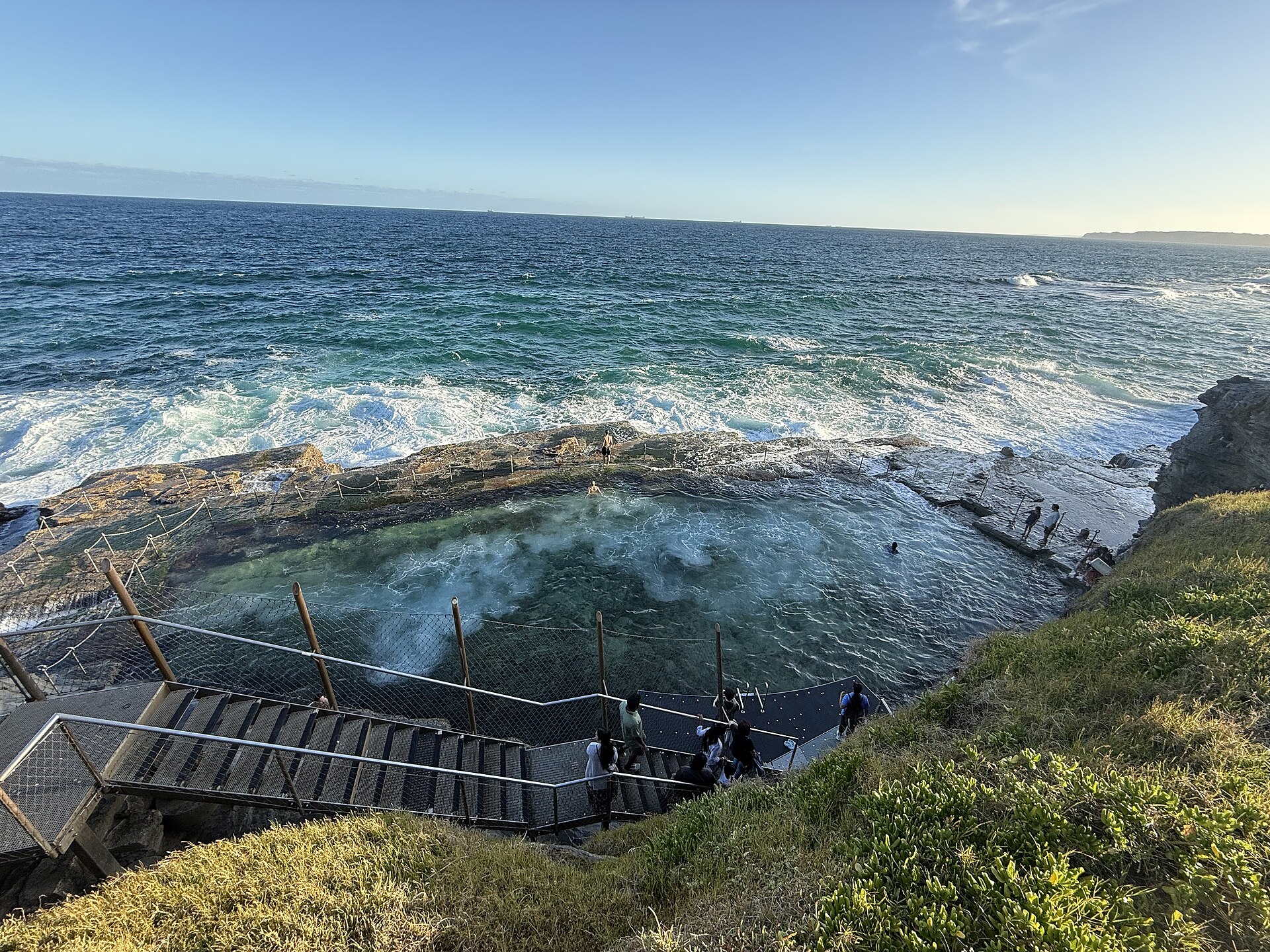
Treat it with respect. In big seas the waves over the wall become dangerous, and the Bogey Hole is closed when conditions are bad and periodically for maintenance and cliff-safety work. It was shut for routine works in late 2025. If the gate at the top of the stairs is closed, it’s closed for a reason, and the view from above is still worth the stop.
King Edward Park and the Memorial Walk
Above the Bogey Hole, King Edward Park is a steep, grassy slope with a bandstand and views up and down the coast. A little further on, past Strzelecki Lookout, the Memorial Walk runs a few hundred metres along the clifftop on an elevated steel walkway, with views that stretch from Nobbys to Merewether. It opened in 2015, a hundred years after both Gallipoli and the opening of BHP’s Newcastle steelworks, and it honours the men and women of the Hunter who served in the First World War. Their family names are cut into rows of steel soldier silhouettes along the path. It’s free, open all the time, and one of the best places in the city to watch for whales from May to November. Dogs, bikes and skateboards aren’t allowed on the walkway.
Bar Beach and Dixon Park
South of the Memorial Walk, the path drops down to Bar Beach, a popular family beach, then runs along the sand past Dixon Park to Merewether. This is the quietest stretch of the walk, and the best for simply lying on the sand.
Merewether Beach and the Merewether Ocean Baths
The walk ends at Merewether, the city’s best-known surf beach, where the Merewether Ocean Baths are often described as the largest ocean baths in the Southern Hemisphere. Opened in 1935, they have a large main pool with lanes and starting blocks and a shallower children’s pool, and they’re free and open year-round. During the swimming season they’re cleaned every Thursday, so check before planning a Thursday-morning swim.
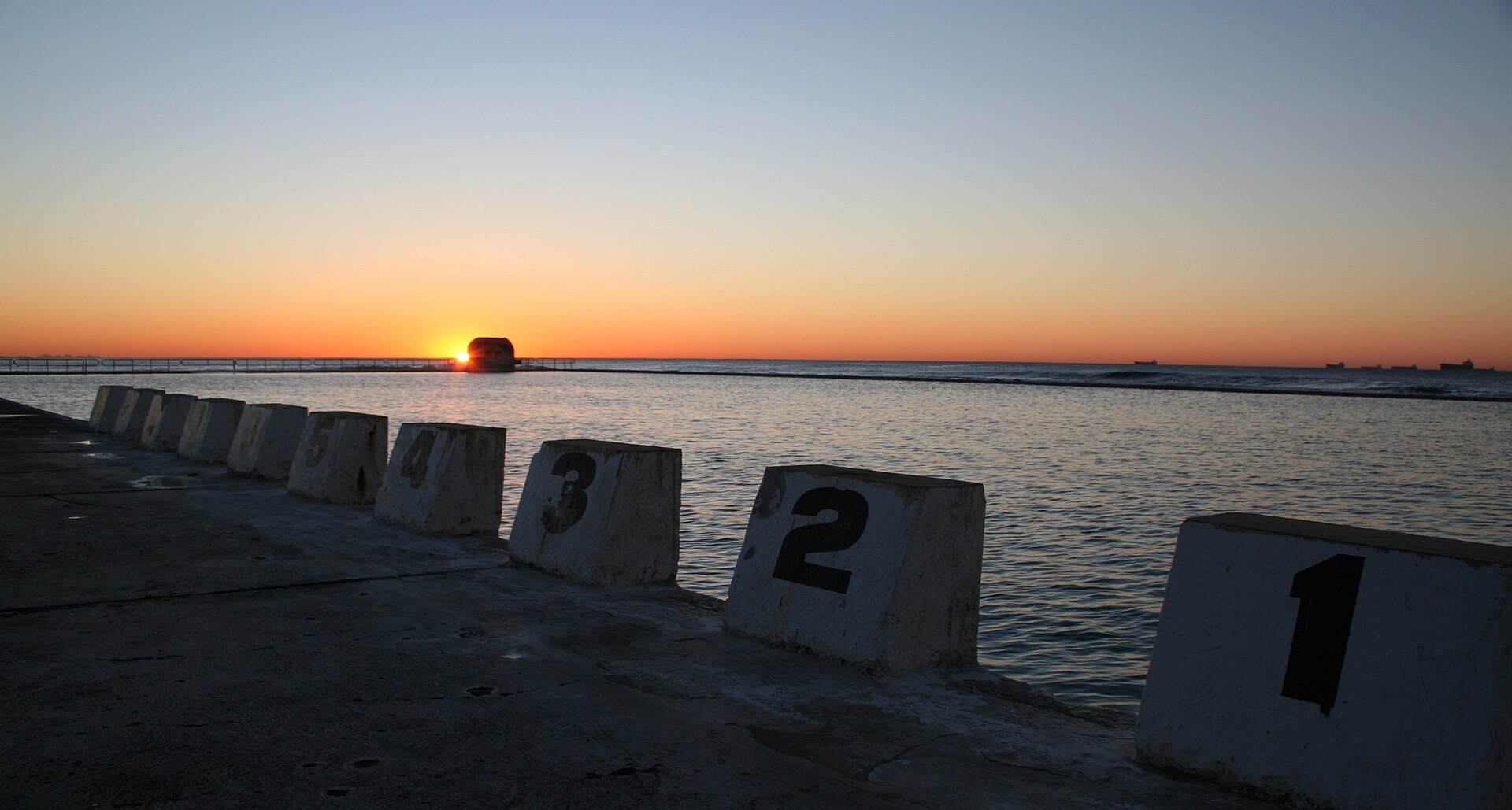
Merewether also hosts Surfest, the city’s big surfing competition, usually in late summer. For more on catching a wave around Sydney, see our surfing guide. When you’re done, local buses and rideshares run back to the city centre, or you can walk back along the coast the way you came.
If you’ve walked Bondi to Coogee, the Bathers Way will feel familiar: the same pattern of headland, beach and ocean pool, just with fewer people, bigger ships, and cheaper coffee at the end. Our guide to Sydney’s ocean pools has the city’s own collection for comparison.
Nobbys Head and Fort Scratchley
Nobbys Head was once an island at the harbour mouth. Between 1818 and 1846 convicts built a breakwater out to it, and today you can walk out along that wall, then continue along the outer breakwall that protects the harbour entrance. It’s one of the best walks in the city: flat, windy, and remarkably close to the coal ships as they’re nudged in and out by tugs. The headland is crowned by the Nobbys Head Lighthouse, first lit in 1858, and a signal station. The grounds open for tours from time to time; check locally if you’d like to go up.
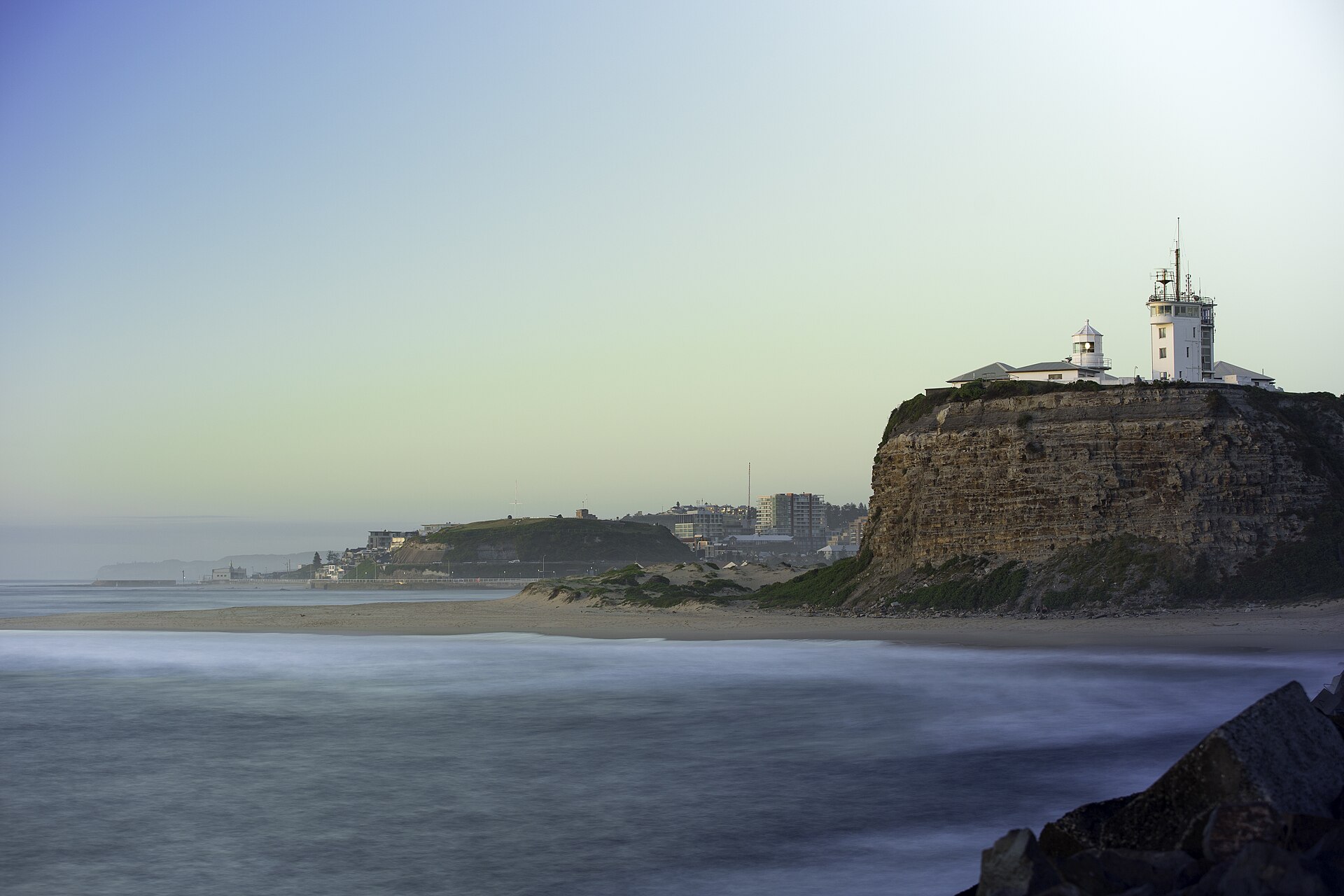
On the hill behind the beach, Fort Scratchley guarded the harbour from the 1880s through the Second World War. Its moment of fame came in June 1942, when a Japanese submarine shelled Newcastle and the fort fired back, which makes it the only coastal fort in Australia to have engaged an enemy warship in wartime.
- Hours: 10am to 4pm, six days a week. Closed on Tuesdays, Good Friday and Easter Sunday.
- Entry: free to the grounds, gun emplacements and exhibits.
- Tunnel tours: guided tours of the tunnels under the fort run at set times through the day (10:30am, 11:30am, 1:10pm, 1:40pm and 2:30pm). They’re paid, need booking, and are the best part of the visit, so book ahead on the City of Newcastle’s Fort Scratchley site.
Even without a tour, the view from the ramparts over the harbour mouth, Nobbys and the ocean is worth the short climb from the beach.
The city
Honeysuckle and the harbour
The Honeysuckle foreshore is where the old railway wharves have become a long promenade of restaurants and bars facing the harbour. It’s the natural place for a drink at the end of the day, watching the tugs bring the ships in. The Newcastle Museum is here too, in the old railway workshops. It’s free to enter and does an excellent job of telling the city’s story through coal, steel and the 1989 earthquake, with a hands-on science gallery that makes it one of the better rainy-day options for kids. Check its opening days before you go.
Darby Street and Hamilton
Darby Street in Cooks Hill is the city’s best strip for coffee, breakfast, bookshops and a laid-back evening drink. It’s a short walk uphill from the centre. For dinner, Beaumont Street in Hamilton has a long run of Italian restaurants, many dating from the migrants who came to work in the steelworks after the war, and it’s a short ride from Newcastle Interchange.
Christ Church Cathedral and the East End
The Anglican Christ Church Cathedral stands on the hill above the city, visible from all over town, and the view from its grounds over the rooftops to the harbour is worth the climb. Below it, the East End’s old streets, with the former Customs House, grand bank buildings and pubs, are being slowly redeveloped, but still reward an hour’s aimless wander between the beach and the harbour.
The Stockton ferry
For the best view of the city, take the little ferry from Queens Wharf across the harbour to Stockton. It’s a five-minute ride on Opal. From the Stockton side you see the whole Newcastle waterfront, Nobbys and the harbour mouth laid out in front of you, and the beach on the ocean side marks the southern end of the dunes that run all the way to Anna Bay. Our Port Stephens guide covers the dunes properly.
Beyond the city
- Blackbutt Reserve, in the suburb of New Lambton Heights, is a large bushland reserve with walking tracks and enclosures of native animals, including koalas. It’s free to enter and a good hour or two with children.
- Lake Macquarie, Australia’s largest coastal saltwater lake, lies just south of the city, and the train runs close to its western shore. It’s more of a place to stay and potter than a day-trip sight.
- The Hunter Valley wine country is about an hour inland from Newcastle. Combining the two in one day is too much, but they make a good two-night trip. See our Hunter Valley guide.
- Port Stephens, an hour north, has dolphins, the Stockton dunes and quieter beaches, and it pairs naturally with a night in Newcastle.
Three ways to do Newcastle
| Plan | What you do | Travel time | Best for |
|---|---|---|---|
| The train day | Light rail to the beach, Bathers Way to Merewether, lunch, Nobbys and Fort Scratchley, drinks at Honeysuckle | About 5 hours on trains | Walkers and swimmers happy with a long day |
| The drive | The same, with Blackbutt Reserve or a Central Coast stop added | About 4 hours in the car | Families, anyone carrying beach gear |
| The overnight | Coast walk and Nobbys on day 1, Fort Scratchley tunnels, Stockton ferry and Darby Street on day 2, or on to Port Stephens | Split over two days | Almost everyone |
The train day, hour by hour
Catch a train from Central by about 7am and you’ll be at Newcastle Interchange around 9:30. Take the light rail to Newcastle Beach, have a coffee and a swim at the ocean baths, then walk the Bathers Way south past the Bogey Hole, the Memorial Walk and Bar Beach to Merewether, arriving for a late lunch. Get a bus or rideshare back to the East End mid-afternoon, walk out along the Nobbys breakwall and climb to Fort Scratchley before it closes at 4pm, remembering it’s shut on Tuesdays. Finish with a drink at Honeysuckle and ride the light rail back to the Interchange for a train home, with Central about two and a half hours later. It’s a full day, but a very good one.
Why the overnight is better
Five hours on a train for about eight hours on the ground is a fair trade, but a single night in Newcastle changes the trip completely. You get the Bathers Way in the golden light of late afternoon, dinner on Beaumont Street or Darby Street, a sunrise swim at Merewether or the Bogey Hole before the crowds, and time for the Fort Scratchley tunnels. Accommodation is also far cheaper than in Sydney, with hotels in the East End and along the harbour and apartments near the beaches.
When to go
- Summer (December to February) is peak season for the beaches and baths. Weekends are busy but never Bondi-busy. Surfest usually falls in late summer at Merewether.
- Autumn (March to May) is the sweet spot: warm water, settled weather and fewer people.
- Winter (June to August) is mild on the coast, and it’s whale season. The Memorial Walk, Strzelecki Lookout and Nobbys are all good vantage points, and the ocean baths still have their hardy regulars.
- Spring (September to November) brings warming days, whales heading back south and windy afternoons.
Our whale watching guide covers the season in more detail. Whatever the month, check the swell before planning a swim at the Bogey Hole.
Is Newcastle worth the trip from Sydney?
Yes, if you like the coast. The Bathers Way is as good as any urban coastal walk in Australia, the ocean baths and the Bogey Hole are unique, and the city has a relaxed confidence that makes it enjoyable just to wander. It also has none of the tourist pricing of the harbour-side areas of Sydney.
But be honest with yourself about the travel. As a day trip, Newcastle means about five hours on a train, which is double what it takes to reach the Wollongong coast to the south. If you only have one day and simply want beaches and ocean pools outside Sydney, Wollongong is the easier choice. If you have a night to spare, or you’re heading on to Port Stephens or the Hunter anyway, Newcastle is the better trip.
Newcastle FAQ
How long is the train from Sydney to Newcastle?
About two and a half hours from Central to Newcastle Interchange on the Central Coast and Newcastle Line, paid with Opal. From the Interchange, the light rail takes you on to Newcastle Beach.
Is Newcastle worth a day trip from Sydney?
Yes, but it’s a long day with around five hours of travel. It’s better as an overnight trip, or combined with Port Stephens or the Hunter Valley.
How do I get from Newcastle station to the beach?
Take the light rail from Newcastle Interchange to its terminus at Newcastle Beach, six stops away. It costs A$2.20 on Opal, or 20 cents if you tap on within an hour of leaving the train.
Can you swim at the Newcastle Ocean Baths?
Yes, the ocean baths are free. They’re part of a staged council upgrade, however, so check the City of Newcastle website for closures before a special trip. Merewether Ocean Baths, at the other end of the Bathers Way, are open year-round.
Is the Bogey Hole open?
Usually, but it closes in dangerous seas and periodically for maintenance. It reopened after routine works in late 2025. If the gate at the top of the stairs is locked, don’t go down.
Is Fort Scratchley free?
Yes, general entry is free. It’s open 10am to 4pm and closed on Tuesdays, Good Friday and Easter Sunday. Guided tunnel tours are paid and should be booked in advance.
Newcastle or Wollongong for a day trip?
Wollongong is closer, at about an hour and a half by train, and better for a single day. Newcastle has the better city and the more impressive ocean baths, and it’s the better choice if you can stay a night.
Related Sydney guides
- Day trips from Sydney — everything within reach of the city, compared.
- Port Stephens from Sydney — dunes and dolphins, an hour beyond Newcastle.
- Hunter Valley from Sydney — the wine country inland from Newcastle.
- Central Coast day trip — beaches and lagoons on the way north.
- Wollongong and the Grand Pacific Drive — the closer coastal trip to the south.
- Southern Highlands from Sydney — gardens and villages south-west of the city.
- Sydney’s best ocean pools — the city’s own tidal pools.
Photo Credits
Merewether Beach looking north: Merewether Beach, Newcastle NSW, December 2025 02 by DaHuzyBru, CC BY-SA 4.0, via Wikimedia Commons.
Newcastle Ocean Baths and the Cowrie Hole: Cowrie Hole and Newcastle Ocean Baths, Dec 2025 01 by DaHuzyBru, CC BY-SA 4.0, via Wikimedia Commons.
The Bogey Hole at high tide: Bogey Hole, December 2025 02 by DaHuzyBru, CC BY-SA 4.0, via Wikimedia Commons.
Merewether Ocean Baths at sunrise: Merewether Baths at sunrise in winter. – panoramio by Rob Freijs, CC BY-SA 3.0, via Wikimedia Commons.
Nobbys Head Lighthouse at dusk: Good Night Nobbys Head Lighthouse – panoramio by Tony Hugo, CC BY-SA 3.0, via Wikimedia Commons.