The Three Sisters and Echo Point: How to Visit
How to visit the Three Sisters at Echo Point: getting there from Sydney, when to come so you are not sharing it with four coaches, the twenty-minute walk onto the first Sister, and the truth about the legend.

There is a car park, a visitor centre, a coach bay and an ice cream queue, and then you walk twenty metres to a railing and the ground simply stops. That is the experience of the Three Sisters Blue Mountains visitors come for, and the reason it survives being one of the most photographed views in Australia is that the scale of what is behind the railing is not something a crowd can spoil. Three sandstone pillars in the foreground; a valley running sixty kilometres to the horizon behind them.
This page is about the lookout and the rock: what you are actually looking at, how to get there, when to come so you are not sharing it with four coaches, what the short walk to the first Sister involves, what the Giant Stairway really is, and which of the stories told about the place are true. Prices and access were checked in September 2026; the lookout itself is free and always has been.

At a glance
| Detail | What to know |
|---|---|
| Where | Echo Point Road, Katoomba, NSW |
| Cost | Free. Parking is metered |
| Open | Always. The visitor centre keeps daytime hours |
| From Katoomba station | 2.5 km, or bus 686 / 686G |
| Accessibility | Paved, level terraces at the main lookout |
| Three Sisters Walk | About 1 km return to Honeymoon Bridge, 20–30 min |
| Giant Stairway | Roughly 900 steel steps into the valley — not a casual add-on |
| Quietest times | Before 09:00 and after 16:00 |
| Best light | Late afternoon, and the hour after sunrise |
What you are actually looking at
The Three Sisters are what is left when a cliff loses an argument with water. The escarpment here is Triassic sandstone laid down around 200 million years ago, sitting on softer shale. Water gets into vertical joints in the sandstone, widens them, and eventually isolates a section of cliff into a standing column. Given long enough the column falls. The Sisters are simply three of these columns that have not fallen yet, in a stretch of escarpment doing the same thing everywhere along its length.
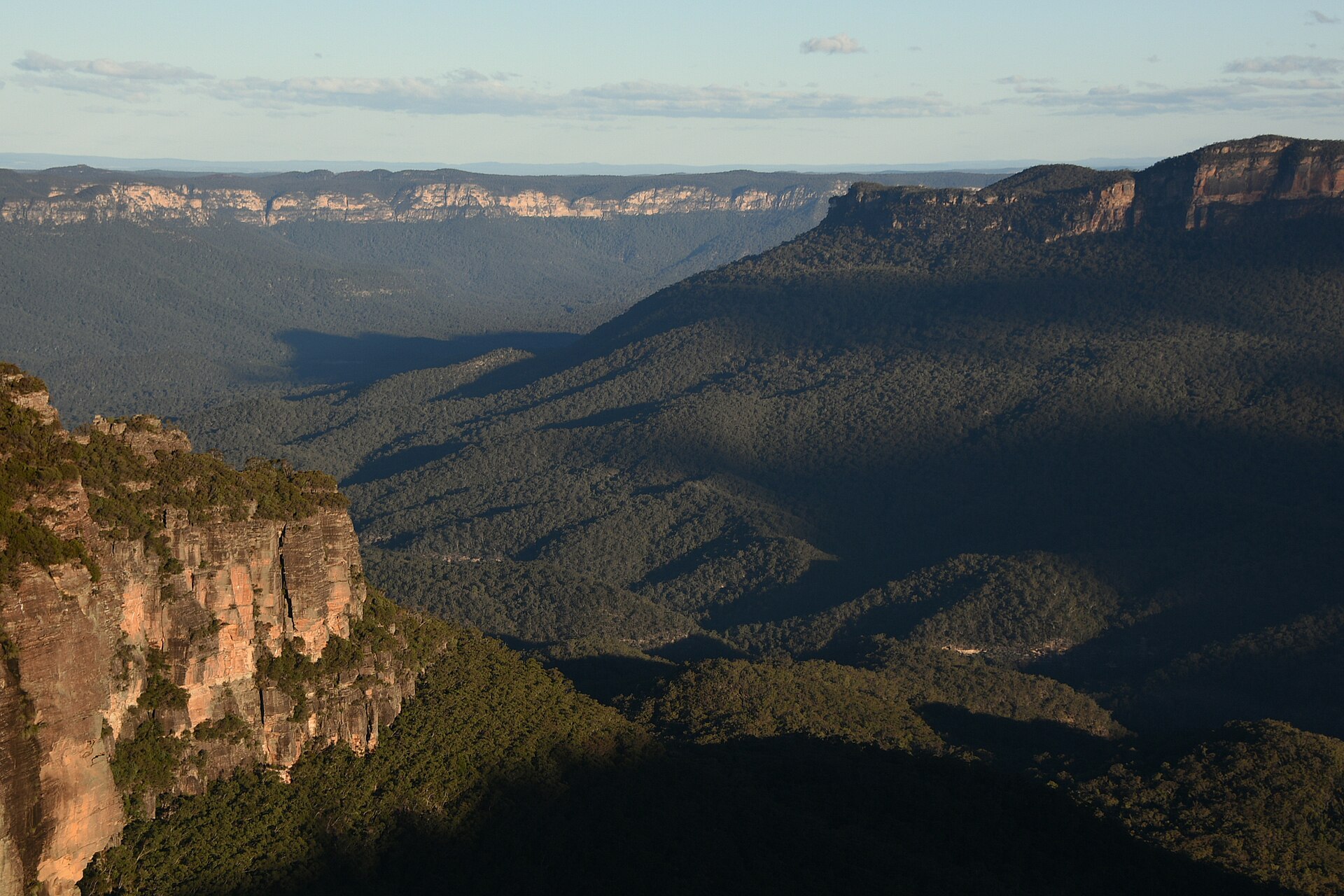
They are, in other words, less special than they look and more temporary than they feel. The tallest is around 900 metres above sea level and stands roughly 30 metres proud of the cliff line beside it. The valley behind is the Jamison, and the reason it goes blue on a warm afternoon is eucalyptus oil vapour scattering short-wavelength light — the same physics that makes the sky blue, running at ground level over a forest the size of a county.
The story about the story
You will be told, at the lookout and in most guidebooks, that three sisters named Meehni, Wimlah and Gunnedoo were turned to stone by a clever man to protect them, and that he died before he could reverse the spell. It is a good story and it is very widely repeated.
It is also, according to a good deal of scholarship and to Gundungurra people themselves, not a traditional Aboriginal story at all — it appears to have been written in the twentieth century by a non-Aboriginal author and then absorbed into the tourist literature until it became indistinguishable from tradition. The country here is Gundungurra and Darug, it has been occupied for tens of thousands of years, and there are genuine cultural narratives attached to this escarpment. They are not the one on the plaque. If this matters to you — and it should — seek out Gundungurra sources rather than the visitor-centre version, and start with our guide to Aboriginal culture in Sydney.
Getting to Echo Point
Without a car
Train from Central to Katoomba on the Blue Mountains Line, about two hours, with an adult Opal fare of A$10.66 at peak or A$7.46 off-peak each way. From the station, Echo Point is 2.5 kilometres — downhill on the way there and uphill on the way back, which is the geometry that ruins more afternoons here than anything else.
Walk down Katoomba Street, which takes 30 to 35 minutes and passes the town’s high street, and take the 686 or 686G bus back up when your legs have had enough. Both run on a standard Opal fare and count towards your daily cap. There is usually a taxi rank at the station. Details are in our Sydney to Blue Mountains train guide.
With a car
Metered parking at the lookout, full by mid-morning on fine weekends and through NSW school holidays. The overflow is a genuine walk back uphill. The drive from Sydney is about ninety minutes on a clear run — see our guide to driving in Sydney.
When to come
This is the whole game, and it costs nothing to get right.
- Before 09:00. The coach tours from Sydney start arriving from around 10:30 and the lookout is transformed. Early morning is cold, often cloud-filled, and frequently empty.
- After 16:00. The coaches leave, the light warms, and the sandstone does the thing it is famous for. This is the best hour of the day here and most day-trippers are already walking back to the station.
- Avoid 11:00 to 14:00 in school holidays. Not because it is unpleasant, but because you will be queueing for a photograph and the overhead light flattens the valley into haze.
- Winter mornings. Cloud sits in the valley below the lookout and burns off around ten. If you arrive and the valley is full of white, wait forty minutes rather than leaving — it is a better sight than the clear view.
A note on the floodlights
The Sisters are floodlit after dark, which is worth ten minutes if you are staying overnight in Katoomba and worth precisely nothing as a reason to plan your day around. It is a lit rock in the dark. The reason to be up here in the evening is the sunset that precedes it and the silence that follows.
The Three Sisters Walk
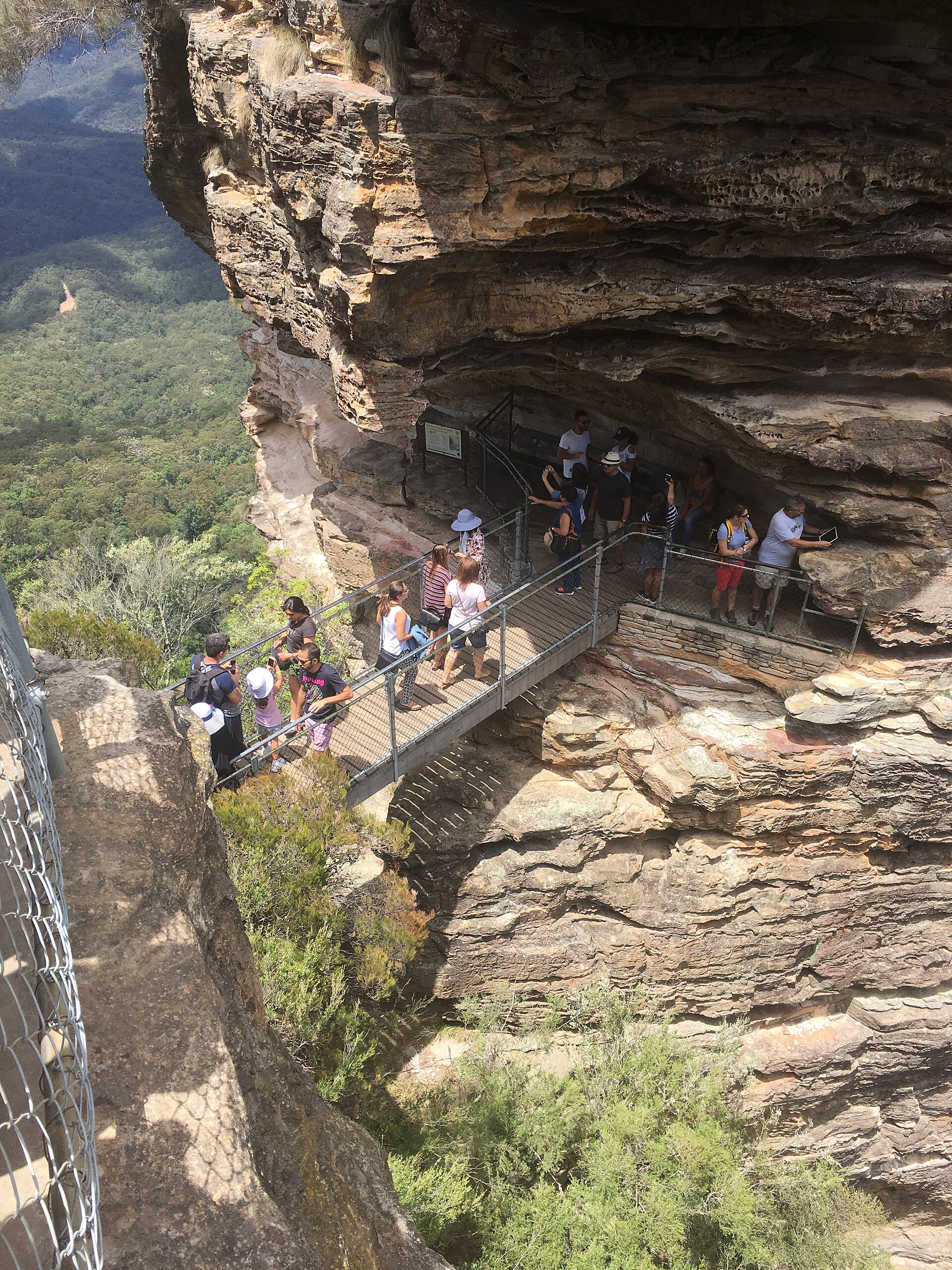
From the eastern end of the Echo Point terrace, a sealed path descends through bush to a series of small lookouts and then to Honeymoon Bridge, a short steel span that puts you physically onto the first Sister. About a kilometre return, twenty to thirty minutes, some steps towards the end, and by a wide margin the best effort-to-reward ratio in the Blue Mountains.
Do this even if you do nothing else all day. Standing on the rock changes what the view means: from the terrace the Sisters are scenery, and from Honeymoon Bridge you are on the object, with cliff on one side and about two hundred metres of nothing on the other. It is fenced and entirely safe, and it is still slightly alarming.
The Giant Stairway
Below Honeymoon Bridge, the path becomes the Giant Stairway: roughly 900 steel and stone steps bolted to the cliff, dropping several hundred metres to the valley floor. It is spectacular, it is properly maintained, and it is not a casual extension of a twenty-minute walk. People make that mistake constantly.
Three things to understand before you start down:
- It is a descent, and descents are harder on knees than climbs are on lungs. Most people find the way down worse than they expected.
- There is no shortcut back up. Once you are at the bottom you either climb back — which almost nobody does — or you walk the Federal Pass west along the base of the cliffs to Scenic World, roughly an hour, and ride out on the Railway or Cableway. Budget two to three hours for the full loop, and check that Scenic World is open before you commit: it opens at 10:00 on weekdays and 09:00 at weekends, and closes at 16:00 and 17:00 respectively. Our Scenic World guide has the current times and prices.
- Alternatively, walk out up the Furber Steps beside Katoomba Falls, which is free and adds several hundred vertical metres of climbing. This is the walker’s version and it is a genuinely good four-to-five-hour day.
Carry water. There is nothing to buy on the valley floor, mobile coverage is nil, and the temperature down there behaves differently from the temperature at the rail.
The rest of Echo Point
The visitor information centre
Staffed, free, has toilets, and holds current track-closure information — which in this region is genuinely useful, because closures here last years rather than weeks. Ask them about your specific walk on the day. They will also tell you which of the nearby tracks is currently shut, and there are usually several.
The Prince Henry Cliff Walk
The clifftop track runs west from Echo Point towards Scenic World and Katoomba Falls, and east towards Leura. The western section takes about 45 minutes at a walking pace and passes a string of small, unphotographed lookouts with the same valley and none of the crowd. It is the single best free 45 minutes of a Blue Mountains day and most visitors never leave the terrace.
Lady Darleys and the eastern lookouts
Head east along the cliff instead and within ten minutes you are alone, looking at the Sisters from behind and side-on, with Mount Solitary across the valley. If Echo Point is heaving, walk two hundred metres in either direction and the problem solves itself.
What to skip
The souvenir retail at Echo Point is unremarkable and the food is priced for a captive audience with a view. Nobody needs a paid “viewing experience” here; there is one lookout, it is free, and you are standing on it. And do not spend forty minutes queueing for the exact frame everyone else has when the same valley is visible, uncrowded, from the cliff walk in either direction.
One genuine warning rather than a grumble: stay behind the fences. The sandstone at cliff edges here is friable, undercut in places, and gives way without notice. There are fatalities in this landscape most years, and almost all of them involve someone stepping past a barrier for a photograph.

With children, and with limited mobility
Echo Point is one of the easier headline attractions in New South Wales to bring a family to. The terraces are paved and fenced, there are toilets and a staffed desk, the view arrives immediately without a walk, and the Three Sisters Walk is short enough to hold a small child’s attention and dramatic enough to reward it. Honeymoon Bridge is a genuine hit with children of about six upwards, who tend to grasp faster than adults that they are standing on the rock in the photograph.
What does not work with children is the Giant Stairway. Nine hundred steps down with no way back up other than an hour of valley walking is not an outing you want to be halfway through when someone announces they are tired. If the valley floor is the goal, buy a Scenic World pass and ride down instead — see our family day trips guide for how the mountains compare with the gentler excursions.
For visitors with limited mobility, the main terraces are the accessible part and they are the best part. Accessible parking and toilets are on site. Everything below the terrace involves steps within a few minutes. The Prince Henry Cliff Walk is well-formed but has sections of uneven ground and steps, so treat it as a walking track rather than a promenade.
Mount Solitary, and what else is in the frame
Most people photograph the Sisters and never identify anything else they are looking at, which is a shame, because the Jamison Valley is legible once you know three landmarks.
- Mount Solitary — the long flat-topped mountain sitting in the middle of the valley, directly opposite the lookout. It is an island of the old plateau that erosion has not yet connected back to anything, and it is a serious two-day walk to climb.
- The Ruined Castle — the knobbly ridge running west from Mount Solitary, named for exactly what it looks like. It is reachable on a long day walk from the valley floor.
- Narrow Neck — the long plateau finger extending south on your right, separating the Jamison Valley from the Megalong. The fire trail along the top is a popular walk and mountain-bike route.
Knowing those three turns a photograph into a map, and it explains something about the region that the lookout does not: this is not a mountain range with valleys cut into it, it is a plateau with the valleys eating outwards. Mount Solitary is what will be left of the bit you are standing on, eventually.
Combining it with the rest of a day
Echo Point takes an hour with the Three Sisters Walk included, which leaves plenty of day. The natural sequence, and the one our day trip itinerary follows, is Echo Point early, the Prince Henry Cliff Walk west, then Scenic World, then lunch on Katoomba Street.
If you have a second day or a car, the Grose Valley lookouts at Blackheath — Govetts Leap and Evans Lookout — are bigger, wilder and far emptier than this, and most visitors never see them. The regional guide covers the whole picture, including where to stay if one day turns out not to be enough.
Frequently asked questions
Is Echo Point free?
Yes. The lookout, the terraces, the Three Sisters Walk and the cliff walks are all free and open at all hours. Parking is metered, and that is the only cost unless you buy an ice cream.
How do I get to the Three Sisters from Sydney?
Train from Central to Katoomba on the Blue Mountains Line, about two hours and an adult Opal fare of A$10.66 at peak or A$7.46 off-peak each way, then bus 686 or 686G, a taxi, or a 2.5-kilometre walk downhill. By car it is about ninety minutes via the M4 and the Great Western Highway.
Can you walk to the Three Sisters?
Yes. The Three Sisters Walk from Echo Point is about a kilometre return on a sealed path and takes twenty to thirty minutes, ending at Honeymoon Bridge on the first Sister. It is the walk to do if you only do one.
How many steps is the Giant Stairway?
Roughly 900, descending several hundred metres from Honeymoon Bridge to the valley floor. It is a serious descent and there is no easy way back up — you either climb, or walk the Federal Pass to Scenic World and ride out, or climb the Furber Steps beside Katoomba Falls.
Is Echo Point wheelchair accessible?
The main lookout terraces are paved and level, with accessible parking and toilets. The Three Sisters Walk and everything below it are not.
What is the best time of day for photographs?
Late afternoon, when the light warms the sandstone and the coach traffic has gone, or the hour after sunrise. Midday flattens the valley into haze and fills the terrace with people.
Are the Three Sisters lit up at night?
Yes, they are floodlit after dark. It is a pleasant ten minutes if you are staying in Katoomba and not a reason to reorganise a day trip around.
Is the Three Sisters legend a real Aboriginal story?
The popular version, with three named sisters turned to stone, is widely understood to have been written in the twentieth century by a non-Aboriginal author rather than handed down. This is Gundungurra and Darug country with its own genuine cultural narratives, and they are not the one printed on the tourist signage.
How long should I spend at Echo Point?
Half an hour for the lookout, an hour with the Three Sisters Walk, or two to three hours if you continue along the Prince Henry Cliff Walk. Add two to three more if you take the Giant Stairway down into the valley.
What should I wear?
A layer more than the Sydney forecast suggests. Katoomba runs eight to ten degrees cooler than the CBD and the wind at the rail is colder again. Proper shoes if you are walking below the terrace. Our Sydney packing guide has the rest.
Echo Point sits at the bottom of a town worth a couple of hours in its own right — an Edwardian spa resort that went broke and filled up with bookshops. If you are building a day around the lookout, our guide to Katoomba has the food, the accommodation tiers and the wet-weather options.
The Giant Stairway is the entry point to a whole network of valley tracks, most of which take considerably longer than the sign at the top implies. Our guide to the best Blue Mountains walks puts times and effort ratings against all of them, and flags the ones that are currently closed.
Seeing the Sisters at first light means sleeping close by. A handful of hotels and guesthouses sit within a few minutes’ walk of the lookout, and our where to stay in the Blue Mountains guide lists which are worth the premium and which base towns to consider instead.
Related Sydney guides
- The Blue Mountains from Sydney — the full regional guide, including the lookouts most visitors never reach.
- Blue Mountains day trip itinerary — one day hour by hour, built around an early arrival at Echo Point.
- Scenic World Katoomba — prices, hours and how the Federal Pass connects to the bottom of the Giant Stairway.
- Sydney to Blue Mountains by train — fares, times and the walk from Katoomba station.
- Aboriginal culture in Sydney — context for whose country this is.
- Day trips from Sydney — how the mountains compare with everything else within two hours.
- Things to do in Sydney — for the rest of your trip.
Photo Credits
Honeymoon Bridge and the Giant Stairway: The Giant Stairway by Vincent Öhlander Rice, CC BY-SA 4.0, via Wikimedia Commons.
Late light in the Jamison Valley: (1)Jamison Valley-2 by Sardaka, CC BY-SA 4.0, via Wikimedia Commons.
Three Sisters and valley cloud photographs from the site library, sourced via Pexels.