Getting Around Sydney 2026: Trains, Buses, Ferries & Opal Card Guide
The complete 2026 Sydney transport guide. Master the Opal card, trains, ferries, light rail, Metro, taxis and rideshare with airport tips and route advice for tourists.

Sydney’s public transport hangs together well: trains, buses, light rail, ferries and the driverless Metro (running since 2019, with its harbour crossing under the CBD added in 2024) all run on a single tap-on, tap-off fare system. For visitors, that means you can land at the airport, tap your contactless credit card and travel everywhere from the CBD to Bondi, Manly, the Blue Mountains and the Royal National Park without buying a single paper ticket. This Sydney transport guide covers everything you need: the Opal card, fares and daily caps, getting from the airport, the train, ferry, light rail and Metro networks, taxis and rideshare, hiring a car, walking and cycling, and a quick reference for getting between Sydney’s most-visited attractions.
Quick reference: how to get around Sydney
| Trip | Best option | Approx. time | Cost (Opal adult) |
|---|---|---|---|
| Sydney Airport → CBD | Airport Link train | 13–17 min | AU$18.61 airport access fee + train fare |
| CBD → Bondi Beach | Train + 333 bus | 30–40 min | AU$5–6 |
| CBD → Manly | Ferry from Wharf 3, Circular Quay | About 30 min | AU$9.20 |
| CBD → Taronga Zoo | F2 ferry from Circular Quay | 12 min | AU$7.35 |
| CBD → Blue Mountains (Katoomba) | Blue Mountains Line train from Central | 2 hours | See the Trip Planner |
| CBD → Sydney Olympic Park | Sydney Trains (Metro West not yet open) | Varies by connection | Check the Trip Planner |
| CBD → Cronulla / Royal National Park | Train T4 from Central | 50 min | Depends on time of day (Trip Planner) |
| CBD → Surry Hills / Newtown | Walk or Light Rail | 15–30 min | Free on foot; fares vary by route |
Opal card and contactless payments
Sydney runs a single integrated payment system called Opal. Tap on a reader at the start of your journey and tap off at the end — fares are calculated automatically based on distance and the daily/weekly cap.
Opal payment options
Three options work identically across all transport modes:
- Contactless credit/debit card (Visa, Mastercard, American Express). The simplest choice for visitors — just tap your travel card, phone or smartwatch on the Opal reader. Same fares and caps as a physical Opal.
- Mobile wallets (Apple Pay, Google Pay, Samsung Pay). Same as contactless cards. If you use one card across multiple devices, fares are aggregated.
- Physical Opal card. The card itself is free from Opal retailers (participating convenience stores and newsagents) or online; the minimum top-up is AU$10, or AU$35 at the airport train stations. Worth it only if your home credit card charges high foreign-transaction fees.
Important: only one tap method per trip — don’t use your card on outbound and your phone on the return; you’ll be charged two separate fares without the daily cap.
2026 Opal fares
All fares listed below are adult fares for an Opal/contactless tap on. Children, students, pensioners and concession holders pay around half. Caps reset at 4am every day.
- Trains and Metro: AU$4.33 peak / AU$3.03 off-peak (0–10km), AU$5.38 / AU$3.76 (10–20km). Longer trips cost more; the full distance table is on transportnsw.info.
- Buses: AU$3.30 (0–3km), AU$4.49 (3–8km), AU$5.77 (8km+) at peak times; off-peak AU$2.31, AU$3.14 and AU$4.03.
- Light rail: same as the buses, so AU$3.30, AU$4.49 or AU$5.77 at peak times by distance, and AU$2.31, AU$3.14 or AU$4.03 off-peak.
- Ferries: AU$7.35 for trips up to 9km, AU$9.20 for longer ones such as Circular Quay to Manly.
- Airport gate fee: Adds AU$18.61 each way to the train fare for journeys originating from or terminating at the Domestic or International airport stations.
Daily and weekly caps
- Daily cap (Mon–Thu): AU$19.30 (covers all your trips that day, but not the airport access fee).
- Daily cap (Fri–Sun & public holidays): AU$9.65.
- Weekly cap: AU$50 (Mon–Sun).
- Sunday fares: no separate Sunday cap; Sunday trips come under the same AU$9.65 Friday–Sunday daily cap.
Tip: weekend trips often pay for themselves twice over compared to weekdays — plan your Bondi-to-Blue-Mountains itinerary on Friday-to-Sunday for the cheapest cumulative fares.
Getting from Sydney Airport to the city
Sydney Kingsford Smith Airport (SYD) sits about 9km south of the CBD with International (T1), Domestic (T2 and T3) terminals connected by free shuttle bus. Five options for getting into the city:
1. Airport Link train (recommended for most travellers)
The Airport Link train (T8 line) stops at Central, Museum, St James, Circular Quay, Wynyard and Town Hall. Central is about 10–15 minutes away; Wynyard and Town Hall take longer, depending on your terminal and which way the train goes round the City Circle. On weekdays the first city-bound trains leave International at 4:22am and Domestic at 4:24am, and the gap between trains changes through the day, so check the timetable for yours. Tap on with your contactless card or Opal — the fare is the AU$18.61 airport station access fee plus the train fare, and the Transport NSW Trip Planner shows the total for your stop. The train station is inside both terminals; signage is clear.
2. Bus 420 + train (skips the airport fee)
To avoid the airport gate fee, take Bus 420 from the stop on the Arrivals level outside your terminal to Mascot Station, then a city-bound train to Central. Total fare: AU$6–8. It takes longer than the direct train, so plan it in the Trip Planner if you have a deadline. Best for backpackers and budget travellers; not recommended with bulky luggage.
3. Taxi or rideshare
Under the current fixed-fare trial, a taxi from the rank straight to the designated CBD area costs AU$60 (AU$80 if you ask for a maxi taxi or there are five or more of you); other trips run on the meter. The ride takes 20–30 minutes (longer in peak hour). Uber and DiDi both operate at SYD with marked rideshare pick-up areas at both terminals — fares run AU$35–55. Allow a little extra time for the walk to the pickup zone.
4. Pre-booked airport transfer
Shared shuttles such as Redy2Go run door-to-door to CBD and city hotels from AU$11 per person; ask for a quote for your hotel. Slower than a taxi but cheaper if you’re alone with luggage.
5. Hire car
All major rental brands (Hertz, Avis, Budget, Europcar, Sixt, Thrifty) operate from the airport. Skip a car if you’re staying in central Sydney — parking and tolls usually cost more than rideshares for a 4–5 day trip.
Sydney trains
Sydney Trains is the city’s main rail network, covering eight numbered lines across Greater Sydney. How often trains come depends on the line and the station, so check the timetable for your trip.
- T1 North Shore & Western Line — connects the CBD to North Sydney, the lower North Shore and Hornsby. For Katoomba, take the separate Blue Mountains Line from Central (about 2 hours).
- T2 Leppington & Inner West Line — Newtown, Stanmore, Strathfield and into the south-western suburbs.
- T3 Liverpool & Inner West Line — the old Bankstown branch between Sydenham and Bankstown has closed for its conversion to Metro, and free Southwest Link buses serve those stations until the Metro opens.
- T4 Eastern Suburbs & Illawarra Line — to Bondi Junction (for Bondi Beach buses), Sydney Cricket Ground, Cronulla and Wollongong.
- T5 Cumberland Line — useful for connecting Parramatta with Liverpool.
- T6 Lidcombe & Bankstown Line — short connector.
- T7 Olympic Park Line — the line to Sydney Olympic Park.
- T8 Airport & South Line — the Airport Link.
Hours vary by line: between midnight and 4:30am NightRide buses replace most train services, though some Intercity trains still run after midnight. Check the timetable if you’re travelling late.
Sydney Metro
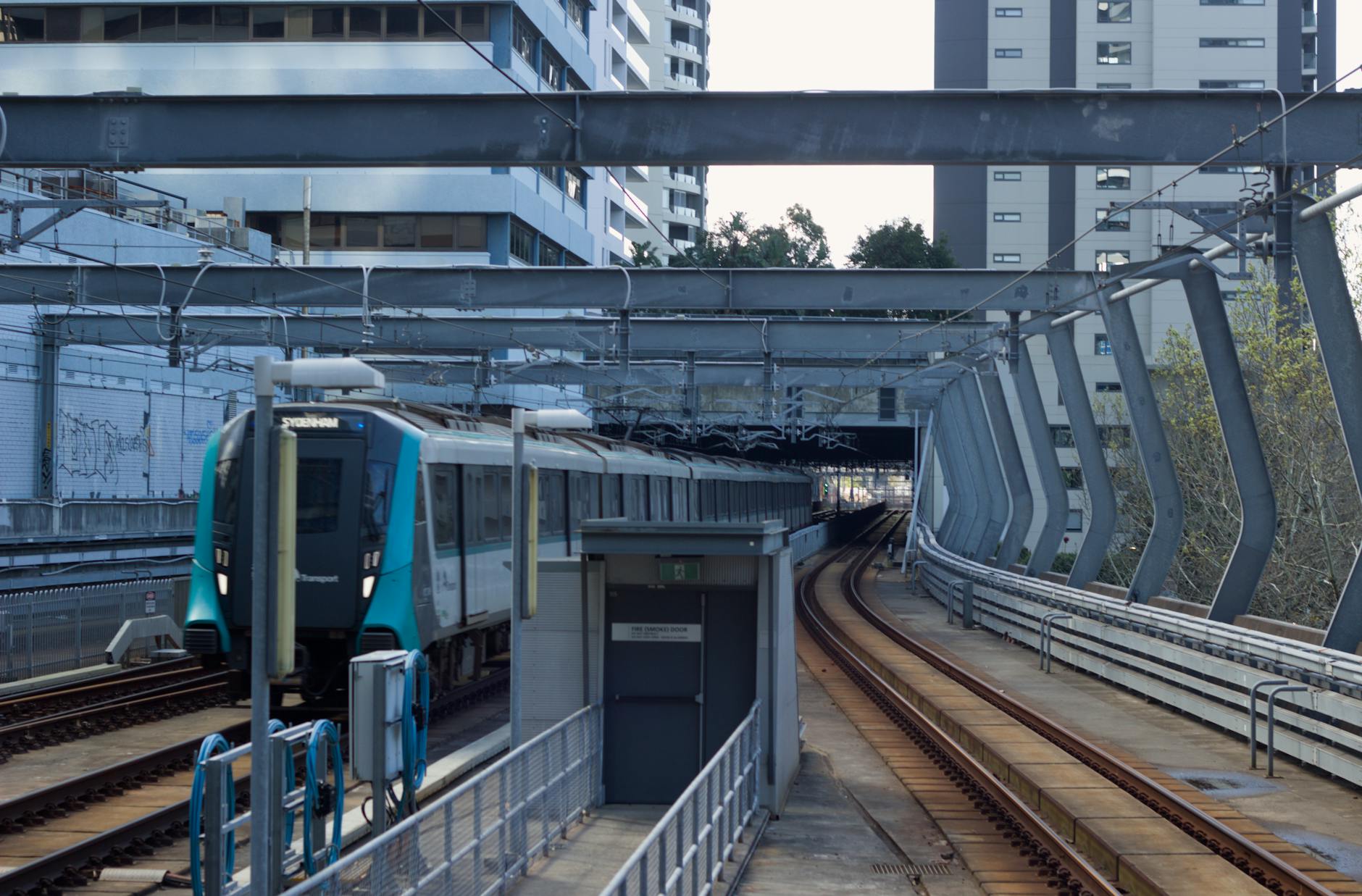
The new Sydney Metro is the city’s first driverless rapid-transit system. The first line (M1, North West Line) runs Tallawong → Chatswood → CBD → Sydenham — the harbour-tunnel section under the Sydney CBD opened in August 2024. Its extension from Sydenham to Bankstown is still to open; until it does, free Southwest Link buses cover the stations on that stretch. New lines under construction include Metro West (Westmead to Bays Precinct) and a Western Sydney Airport line. Trains run every 4 minutes at peak times, every 5 minutes between the weekday peaks and every 10 minutes at other times.
For visitors, the most useful Metro stops are Barangaroo (Crown Sydney, the headland park, Wynyard interchange), Martin Place (CBD) and Central (interchange with main trains and the long-distance NSW TrainLink network). For Sydney Olympic Park, take the T7 train.
Sydney buses
Sydney’s bus network plugs gaps in the train system, especially to beaches and harbour-side suburbs the train doesn’t reach. The most useful tourist routes:
- 333 (Circular Quay – Bondi Beach) — the express route via Bondi Junction, with frequent services every day.
- 380 (Watsons Bay – Bondi – Bondi Junction) — slow scenic route along the eastern beach suburbs.
- L90 (Wynyard – Palm Beach) — limited-stops express to the Northern Beaches.
- 199 (Manly – Palm Beach) — local Northern Beaches service.
- 238 (Taronga Zoo & ferry wharf – Balmoral Beach) — for Balmoral Beach, connecting with the F2 ferry at Taronga Zoo.
- X28 (Bondi Junction – Maroubra) — useful for Coogee, Maroubra surf trips.
All buses are tap-on at the front, tap-off when you exit. Drivers can’t sell tickets — you must use Opal or contactless. Real-time tracking is best with the Opal Travel or Citymapper apps.
Sydney ferries
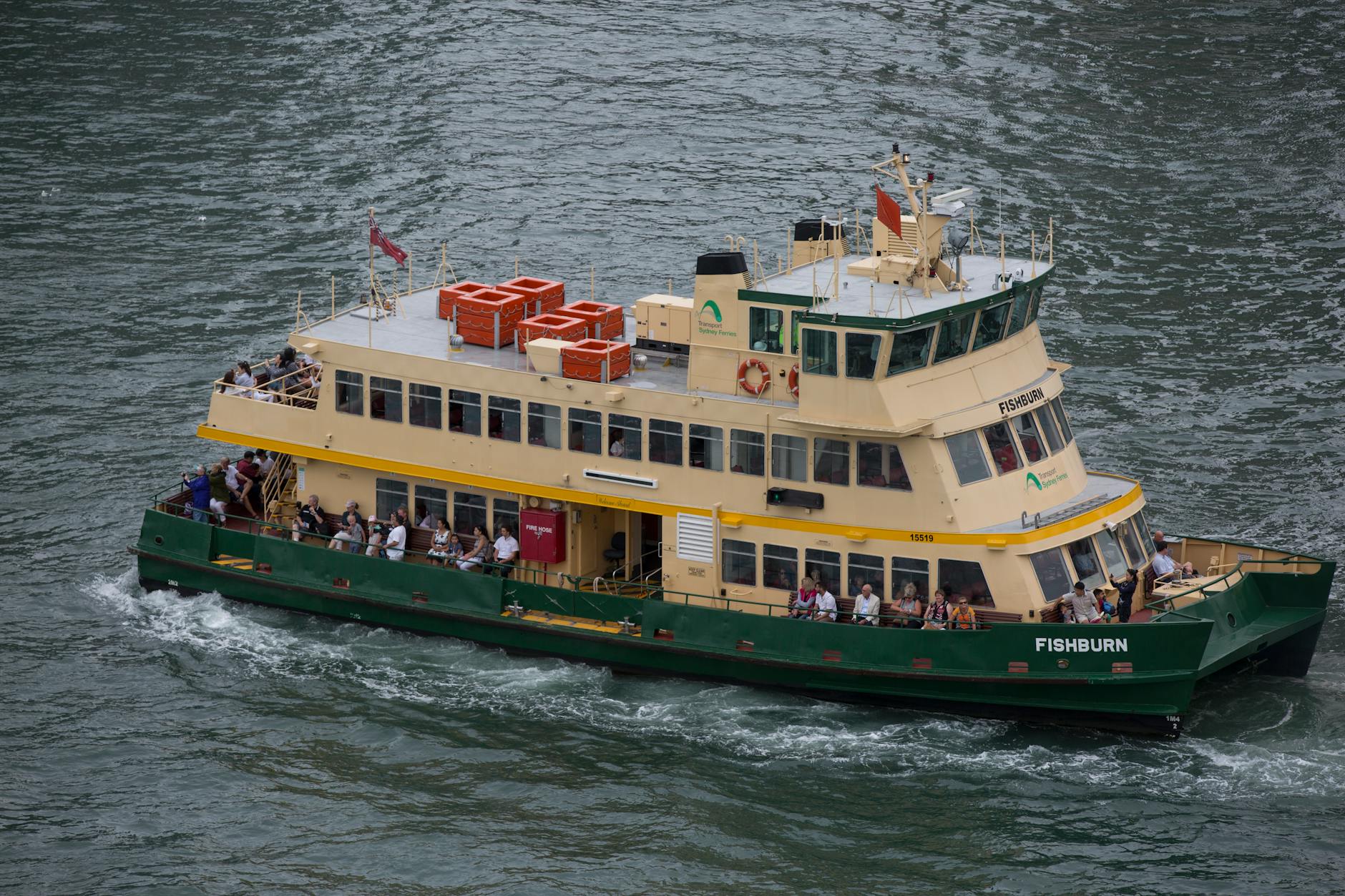
Sydney’s ferries make some of the best sightseeing in the city — for the price of a single ferry fare (AU$7.35 up to 9km, AU$9.20 beyond), you can ride past the Opera House, the Harbour Bridge and the harbour’s sandstone headlands, with Fort Denison on many routes. All major ferries depart from Circular Quay‘s five wharves. The Manly ferry always uses Wharf 3; for every other route, check the indicator screens for your wharf.
- F2 and F9: F2 to Taronga Zoo; F9 to Watsons Bay via Rose Bay.
- F6: Mosman Bay.
- F1 Manly Ferry (Wharf 3): about 30 minutes across the harbour.
- F4: Pyrmont Bay, for Darling Harbour.
- F5: Neutral Bay.
- F3 and F8: F3 up the Parramatta River; F8 to Cockatoo Island.
The faster Manly Fast Ferry takes about 20 minutes between Wharf 2 at Circular Quay and Wharf 2 at Manly, for the same Opal fare as the F1. The Cronulla–Bundeena heritage ferry (run by Cronulla & National Park Ferry Cruises) is also Opal-eligible.

Sydney light rail
Sydney has two light-rail lines (trams):
- L1 Dulwich Hill Line — Central Station via Darling Harbour, the Star casino, Pyrmont, Glebe, Annandale, Lewisham and Dulwich Hill. Great for Glebe Markets, the Sydney Fish Market and the Inner West.
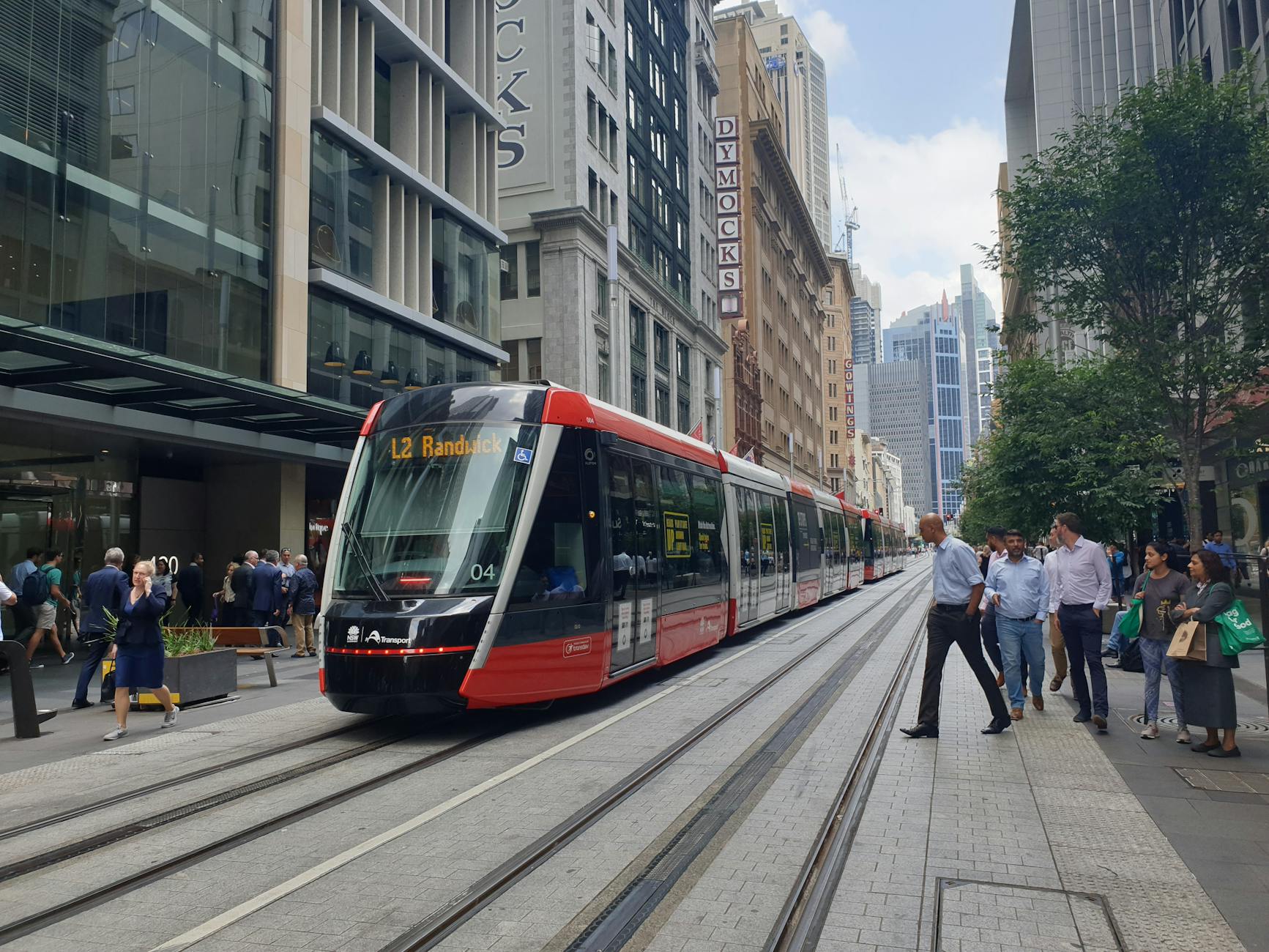
- L2 Randwick Line + L3 Kingsford Line — Circular Quay → George Street pedestrian mall → Town Hall → Central → Surry Hills → Moore Park (SCG) → Randwick / Kingsford.
Light-rail trips are timed by zone (same fare structure as buses).
Sydney taxis and rideshare
Sydney’s main rideshare apps are Uber and DiDi, plus local operator GoCatch. All work with your existing app and credit card from your home country. Surge pricing applies on Friday/Saturday nights and during major events.
Taxis can be hailed on the street, at taxi ranks or booked via 13CABS, Silver Service and Premier Cabs. The maximum rank-and-hail fare is a AU$5.17 hire charge plus AU$2.61/km for the first 12km and AU$2.37/km after that. From 10pm to 6am the distance rates rise to AU$3.10/km and AU$2.82/km, and an extra AU$2.65 peak hire charge applies on Friday, Saturday and pre-public-holiday nights. Fare estimates:
- CBD → Bondi Beach: AU$25–35 (taxi); AU$18–28 (Uber).
- CBD → Manly via Spit Bridge: AU$45–65 taxi; ferry is much cheaper.
- CBD → Sydney Airport: AU$45–65 taxi; AU$35–55 Uber.
- Bondi → Coogee: AU$15–22 taxi; AU$12–18 Uber.
Driving in Sydney
Hire a car for day trips to the Blue Mountains, Hunter Valley or Royal National Park, but skip it for inner Sydney. The reasons:
- Tolls. Almost every motorway in Sydney is tolled (M2, M5, M7, Cross City Tunnel, Eastern Distributor, Sydney Harbour Bridge/Tunnel, NorthConnex, WestConnex). Most rental cars come with an automated toll tag, but tolls add up fast — budget AU$10–25 per day of driving.
- Parking. CBD parking prices vary by car park: Wilson’s 309 Kent Street, for example, lists AU$25 for the first weekday hour and an AU$85 daily maximum, or AU$43 on its Spott Saver rate (enter 5–9:30am, leave 2pm–midnight). Hotel parking is often AU$60–80 per night extra.
- Traffic congestion. Heaviest in the weekday morning and evening peaks.
- Drive on the left. Australia drives on the left side of the road, like the UK and Japan.
- License. Temporary visitors can drive on their current overseas licence for up to six months after arriving; to keep driving after that you need a temporary NSW licence. International Driving Permit recommended if your licence is in another script.
- Speed limits. 50km/h default in built-up areas and 100km/h elsewhere where no sign says otherwise; on motorways, follow the posted or variable limit. Very strictly enforced — extensive speed and red-light camera coverage.
Major rental brands include Hertz, Avis, Budget, Europcar, Sixt, Thrifty, East Coast Car Rentals and (for cheaper used vehicles) Travellers Autobarn. Pickup is easiest at the Sydney Airport rental cluster; CBD rentals usually charge a daily fee for the parking spot.
Walking in Sydney
Sydney’s CBD and inner suburbs are excellent for walking. Much of George Street is now pedestrian-only, with the light rail running down the middle, and you can follow the harbour foreshore from Mrs Macquarie’s Chair → Royal Botanic Garden → Opera House → Circular Quay → The Rocks → Barangaroo → Walsh Bay. Other great walks:
- Bondi to Coogee Coastal Walk (6km, 2 hours)
- Spit Bridge to Manly Walk (10km, 4 hours)
- Cremorne Point Loop (3km)
- Hermitage Foreshore Walk from Rose Bay (1.8km one way, 30 minutes to 1 hour)
- South Head Heritage Trail from Camp Cove, Watsons Bay (1km loop, 30 minutes to 1 hour)
- The Rocks heritage walk (self-guided maps at the Rocks Discovery Museum)
Cycling in Sydney
Sydney has invested heavily in cycle paths over the past decade. The Sydney Harbour Bridge cycleway, the Manly to Spit Bridge shared path, the Bay Run (7km loop around Iron Cove), and the Royal National Park are the standout rides. Bike-share and rental options:
- Lime e-bikes: Dockless rental, around AU$1.20 unlock + AU$0.45/min.
- Beam & HelloRide e-scooters: Hired e-scooters can only be ridden inside the approved trial areas, on the paths, bike lanes and roads designated there, not across Sydney generally.
- Bondi Bike Hire: road or hybrid bikes by the day.
- Manly Bike Tours: Group rides AU$80–110 with bike included.
Helmets are mandatory by law in NSW for cyclists and e-scooter riders — included with all rentals.
Travel apps for Sydney
- Opal Travel — Official trip planner, real-time updates and fare history.
- Citymapper — Cleaner UI, multimodal route planning, walking and cycling included.
- Trip View Lite — Free real-time train/bus/ferry departure boards.
- Linkt — Toll-road balance and account management for hire cars.
- Uber, DiDi — Rideshare.
- Beachsafe — Patrolled beach status and surf forecasts.
Accessibility
All Sydney trains, light rail, Metro, ferries (most wharves) and modern buses are wheelchair accessible. Older bus stops on hilly streets may not have step-free access — check the Transport NSW Trip Planner for accessible routes. The Mobility Map at sydney.com lists accessible attractions, ramps and bathrooms.
Late-night transport
From midnight to 4:30am NightRide buses take over most train services, so check the Trip Planner for the last train or Metro on your line. Last ferries vary by route; look up the final departure before you head out. Some regular bus routes also run 24 hours a day. After hours, rideshare is the easiest option home.
Sydney transport for tourists: top tips
- Tap on, tap off — every leg. Even on the same journey across modes, tap on each new vehicle/wharf reader.
- Use the same payment method all day. Switching between cards or devices breaks the daily cap.
- Keep two payment options ready. Phone batteries die — carry a backup card.
- Beware the airport gate fee. Any train trip to or from the Domestic or International station costs AU$18.61 on top of the fare; Bus 420 to Mascot Station and a train from there avoids it.
- Skip taxis in peak hour. In the evening peak the train is usually the quicker way from the CBD to Bondi or Parramatta.
- Use ferries for sightseeing. The F1 from Wharf 3 to Manly doubles as a harbour cruise for the price of a ferry fare.
- Check the planner before events. Trains, buses and ferries run extra services for major events at Accor Stadium and the Sydney Cricket Ground.

Guides in this pillar
9 guidesFrequently asked questions
What’s the easiest way to get around Sydney as a tourist?
Tap your contactless credit card or phone on the Opal readers. Trains and Metro are fastest for longer trips, ferries are scenic for harbour destinations (Manly, Taronga, Watsons Bay), buses fill the gaps to beach suburbs (333 to Bondi). Walk in the CBD and Royal Botanic Garden — distances are shorter than they look on the map.
Do I need to buy an Opal card as a tourist?
No. Any contactless Visa, Mastercard or American Express card or mobile wallet (Apple Pay, Google Pay) works identically to a physical Opal card and counts toward the same daily and weekly caps. Only buy a physical Opal if your home credit card charges high foreign-transaction fees.
How much does public transport cost in Sydney?
Daily caps are AU$19.30 Mon–Thu and AU$9.65 Fri–Sun and on public holidays. The weekly cap is AU$50. Off-peak fares are slightly lower. A single ferry trip costs AU$7.35 up to 9km and AU$9.20 for longer runs like Circular Quay to Manly.
How do I get from Sydney Airport to the CBD?
Take the Airport Link train to Central, Town Hall, Wynyard or Circular Quay. Central is about 10–15 minutes away, and you pay the AU$18.61 airport access fee plus the train fare (the Trip Planner gives the total). For a cheaper option, take Bus 420 to Mascot Station and a regular train to Central (AU$6–8). A rank taxi to the CBD is a fixed AU$60 under the current trial (AU$80 for a maxi taxi or five or more passengers); rideshares AU$35–55.
Is Uber available in Sydney?
Yes. Uber, DiDi and GoCatch all operate across Sydney including the airport. You can use the Uber account you already have. Inner-city trips run AU$12–25 base fare.
Should I rent a car in Sydney?
Only if you’re doing day trips outside the city. Sydney’s public transport is so good that a car is a liability in the inner city — parking is expensive (AU$15+/hour), tolls are heavy on most motorways, and traffic is congested. Rent for the Blue Mountains, Hunter Valley, Royal National Park or a longer NSW road trip.
Is Sydney public transport safe at night?
Yes. Trains, Metro, ferries and buses are well-staffed, well-lit and CCTV-monitored. NightRide buses and rideshare cover late-night gaps. Use standard travel sense — sit near other passengers in late-night carriages and prefer rideshare for unusual routes after midnight.
Can I take luggage on Sydney trains?
Yes — there’s no luggage fee or size limit on Sydney trains, Metro or buses. Larger luggage is best stored in the priority spaces near accessible doors. Lifts are available at all major stations.
Plan the rest of your Sydney trip
Now that you can navigate the city, dig into our deep-dive transport articles: Sydney Opal card explained, Sydney Airport to CBD options, Sydney ferry routes guide, Sydney trains and Metro lines, renting a car in Sydney, and Sydney to Blue Mountains by train. Pair this guide with our overall things to do in Sydney, where to stay in Sydney, Sydney beaches and Sydney travel planning articles.
Helpful resources for planning your Sydney trip
For the very latest information on opening hours, ticketing and transport, the following official resources are kept up to date:
Helpful resources for planning your Sydney trip
For the very latest information on opening hours, ticketing and transport, the following official resources are kept up to date:
Sydney Airport trips up more visitors than any train line, mostly because the international and domestic terminals sit on opposite sides of the runway. Our Sydney Airport terminals guide explains which airlines use T1, T2 and T3, the free T-Bus between them, and how long a connection really needs.
Arriving or leaving by sea? Sydney has two cruise terminals on opposite sides of the Harbour Bridge, and they couldn’t be more different to reach. One is a short walk from Circular Quay station and the other has no train or ferry at all. Our Sydney cruise port guide explains which is which.
Related Sydney guides
Other guides that make getting around easier:
1 comment