Sydney to Blue Mountains by Train: Times, Fares & What to Do
The Blue Mountains Line explained: the A$10.66 peak and A$7.46 off-peak Opal fares, the A$9.65 Friday-to-Sunday cap, which platform at Central, which station to get off at, and what to do when Katoomba station turns out to be 2.5 km from the view.

Almost every question people ask about the Sydney to Blue Mountains train has the same answer, and it is a boring one: you do not need to do anything. There is no ticket to buy in advance, no seat to reserve, no tourist pass to compare, no app to download. You walk into Central, look at a board, tap a card on a gate and get on. The Blue Mountains Line is an ordinary commuter service that happens to climb a kilometre of sandstone escarpment on its way to one of the best views in Australia.
What follows is the practical detail that does matter: what the fare actually is, how often trains run, which station to get off at, what happens when you arrive at a station that is nowhere near the lookouts, and the handful of things that genuinely go wrong. Everything here was checked in September 2026 and prices are in Australian dollars — verify the current fare before you travel, because Transport for NSW adjusts them each July.
At a glance
| Question | Answer |
|---|---|
| Line | Blue Mountains Line, Central towards Lithgow |
| Journey time, Central to Katoomba | About 2 hours |
| Adult fare, one way | A$10.66 peak, A$7.46 off-peak on Opal |
| Frequency | Roughly hourly, more at peak |
| Booking | None. Tap on, tap off |
| Where to board | Central, intercity platforms 4–9 |
| Best station for the Three Sisters | Katoomba |
| Best station for the Grose Valley | Blackheath, two stops further |
| Distance, Katoomba station to Echo Point | 2.5 km, downhill out, uphill back |
Fares, and the caps that change everything
An adult single from Central to Katoomba is A$10.66 at peak times and A$7.46 off-peak on Opal. You pay it by tapping an Opal card, a contactless bank card or a phone on the reader at the gate, and tapping off at the other end. Forgetting to tap off is the only expensive mistake available to you — it triggers a default fare, and it is entirely avoidable.
Two caps matter for this trip:
- The daily cap. Once you hit it, everything else you travel on that day is free. A mountains return alone will not reach it on a weekday, but a mountains return plus a ferry and some buses often does. That makes the trip effectively cheaper than the sticker price if you have a busy day.
- The Friday-to-Sunday cap. On Fridays, Saturdays, Sundays and public holidays an adult’s Opal travel is capped at A$9.65 a day, against A$19.30 from Monday to Thursday. Under it, a return trip to Katoomba plus every other journey you make that day comes to no more than A$9.65 in total. This is the best-value day out in New South Wales and it is exactly why weekend trains fill up.
Children travel at concession rates, and a child’s daily Opal cap is A$4.80 on Fridays, Saturdays, Sundays and public holidays (A$9.65 from Monday to Thursday). There is no tourist rail pass worth buying for this journey, and anyone selling you a “Blue Mountains rail ticket” as a separate product is selling you something you already have. Our Opal card guide for tourists has the caps and the concession detail in full.
Off-peak matters
Fares drop outside the weekday peaks, and the peak definition is generous — mid-morning departures are usually off-peak. If you are leaving at seven to be at Echo Point before the coaches, you will pay peak on the way out and off-peak coming home. It is a small difference and it should not change your departure time.
Finding the right train at Central
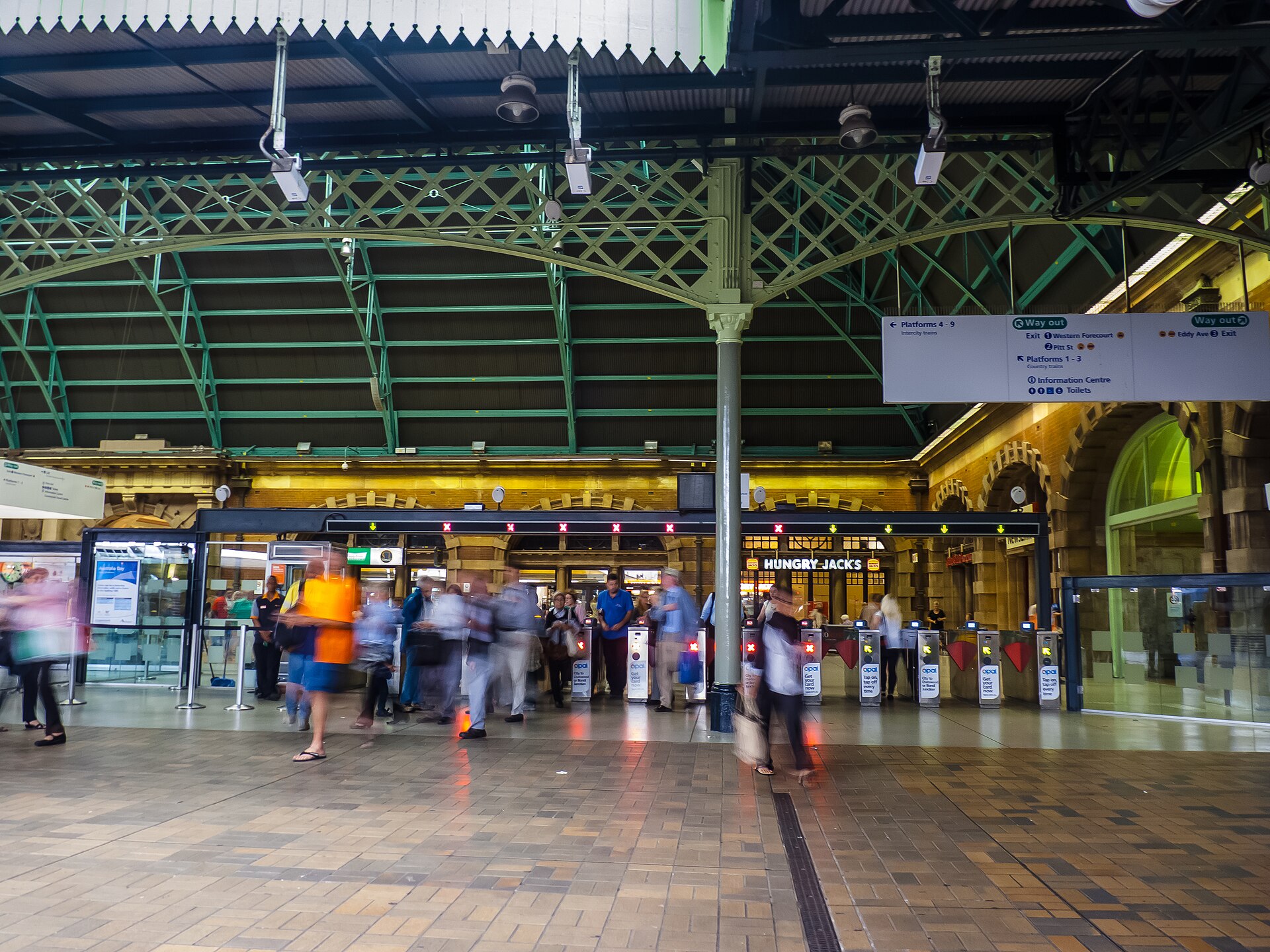
This is where visitors lose ten minutes. Central Station has two personalities. The suburban platforms, where most visitors have been using the network, sit in one part of the building; the intercity platforms — 4 through 9 — sit under the great arched Grand Concourse and serve the long-distance lines including the Blue Mountains.
Look for the departure board listing services towards Lithgow, or occasionally Mount Victoria, Springwood or Emu Plains. Anything terminating at Emu Plains or Springwood stops short of Katoomba, so check the destination rather than just the line name. Give yourself ten minutes at Central rather than three; the concourse is large and the walk to platform 9 is not trivial with luggage.
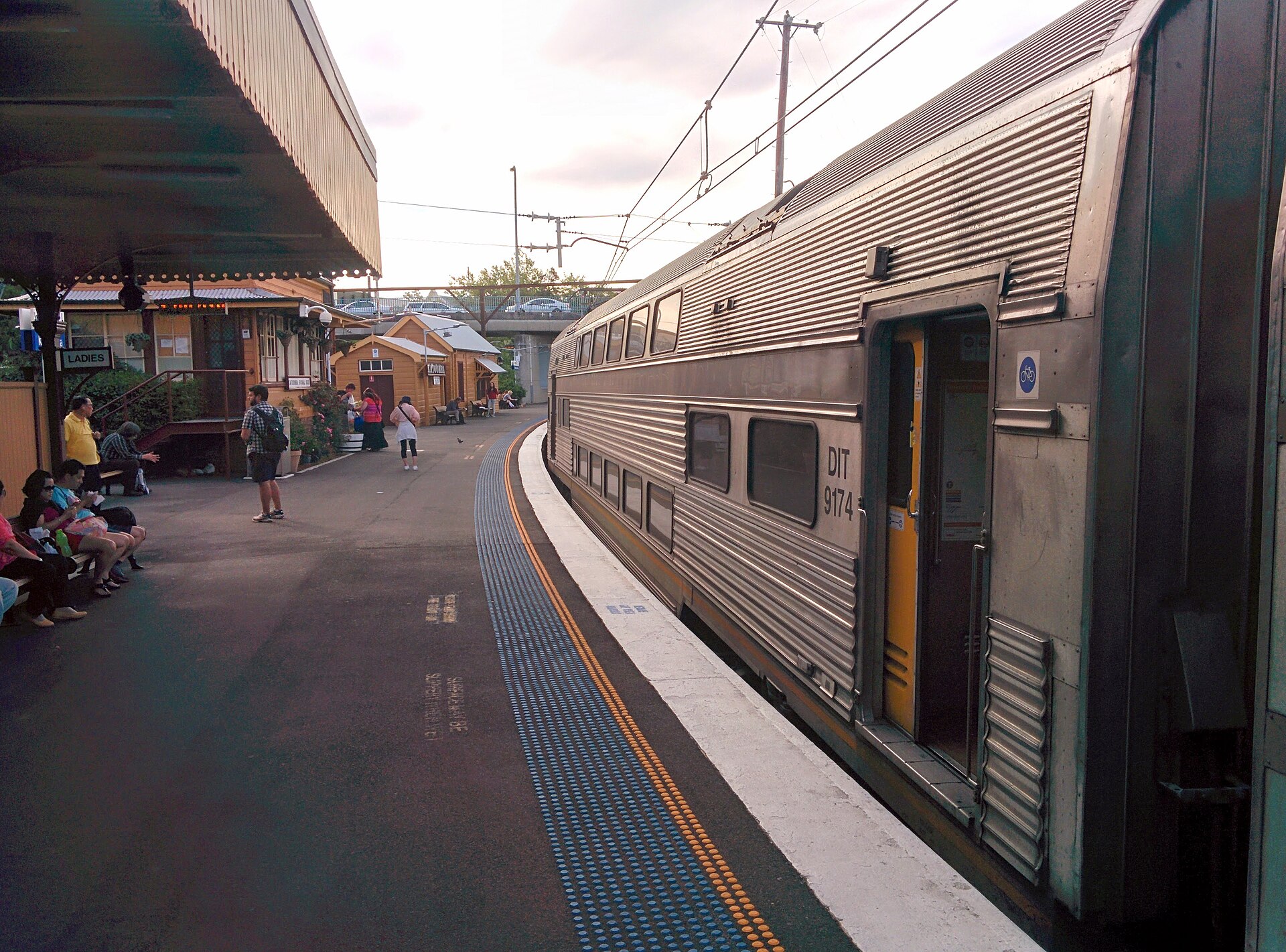
The rolling stock is double-deck intercity, which is a genuinely different experience from a suburban train: reclining seats, more legroom, luggage space, and toilets on board. Sit upstairs on the left-hand side heading west if you can, for the escarpment views on the climb. Our Sydney train network guide explains how the intercity and suburban networks fit together.
The journey itself
Two hours, and the second half is worth staying awake for.
- Central to Parramatta, about 25 minutes — suburban Sydney, not much to look at.
- Parramatta to Penrith, about 30 minutes — the western plains, flat and hot in summer.
- Penrith to Emu Plains, crossing the Nepean River. This is the boundary. On one side is the Cumberland Plain; on the other the ground starts going up.
- Emu Plains to Katoomba, about 50 minutes and roughly a kilometre of climb, through Glenbrook, Springwood, Wentworth Falls and Leura. The line was cut into the escarpment in the 1860s and the engineering shows — cuttings, curves and sudden gaps where the land falls away on one side.
You will feel the temperature change before you see it. By Katoomba the air is noticeably colder and thinner than it was at Central, which is the single most useful thing the journey teaches you about the region.
Which station should you get off at?

Katoomba — the default, and usually right
The main town, the transport hub, and the closest station to Echo Point, the Three Sisters and Scenic World. It has the bus connections, the taxi rank, the cafés and the widest choice of accommodation. Unless you have a specific reason to do otherwise, get off here. Our Blue Mountains day trip itinerary is built around this station.
Leura — one stop earlier
A small station serving a deliberately pretty village of flowering trees, homewares shops and cafés with tablecloths. Leura Mall is about ten minutes’ walk from the platform. It is a good lunch stop and a lovely place to stay, but it is further from the famous views than Katoomba and the walk down to Leura Cascades is a commitment.
Wentworth Falls — for the waterfall
Two stops before Katoomba, and the base for the Wentworth Falls track network. Be aware before you commit a day here that a section of the National Pass, the celebrated cliff-face track, is closed after a landslide, and Wentworth Pass, Slack Stairs and the Valley of the Waters below Sylvia Falls are also closed. Check the current alerts.
Blackheath — for the better valley
Two stops past Katoomba, and quietly the best station on the line for anyone who came to walk. Govetts Leap and Evans Lookout are a short walk or a very short taxi ride away, and they look into the Grose Valley, which is bigger and emptier than the Jamison. The village has the strongest food in the mountains. If you are staying a night rather than day-tripping, consider Blackheath over Katoomba.
Glenbrook and the lower mountains
An hour from Central rather than two, warm rather than cold, and home to swimming holes and the national park’s lower entrances. Worth knowing about if you only have half a day, but you will not see the great escarpment views from down here.
Arriving at Katoomba: the bit nobody warns you about
Katoomba station is not at the lookouts. Echo Point is about 2.5 kilometres away and Scenic World about three, and both are downhill on the way there and uphill on the way back. Plenty of people walk down happily at ten in the morning and then discover what that means at four in the afternoon.
- Walk down, ride back. The best default. Thirty to thirty-five minutes down Katoomba Street, through the town’s high street, and you catch the bus back up when your legs have had enough.
- Bus 686 or 686G. Standard Opal fare, counts towards your daily cap, runs to Echo Point and Scenic World. Perfectly adequate.
- Blue Mountains Explorer Bus. A hop-on-hop-off day pass at around A$30. It pays for itself at about four hops. Most one-day itineraries make two. Skip it unless you are genuinely touring the whole ridge.
- Taxi. Usually a rank at the station, and the sensible answer with small children or in bad weather.
Walking distances from each station
The single most useful table on this page, because it is the thing the timetable does not tell you. All distances are one way from the station entrance, and the return leg is uphill in every case except Blackheath’s lookouts.
| From | To | Distance | On foot |
|---|---|---|---|
| Katoomba | Echo Point and the Three Sisters | 2.5 km | 30–35 min down, 40–45 min back up |
| Katoomba | Scenic World | 3 km | 35–40 min down |
| Katoomba | Katoomba Falls | 2.5 km | 30 min |
| Leura | Leura Mall | 0.5 km | 7–10 min, flat |
| Leura | Leura Cascades | 2 km | 25–30 min down |
| Blackheath | Govetts Leap lookout | 3 km | 35–40 min, mostly level |
| Wentworth Falls | Wentworth Falls lookout | 2 km | 25 min |
Nothing on that list is unreasonable on the way out. All of it is harder on the way back, at the end of a day, with a train to catch. Build the return leg into the plan rather than discovering it.
A short history of the line, which explains the curves
The railway reached the mountains in the 1860s, and the reason the journey takes two hours to cover ninety kilometres is that nineteenth-century engineers had to get a train up a kilometre of sandstone without modern tunnelling. The solution was to follow the ridge — which is why the line runs along the spine of the plateau, why every mountains town sits within a few hundred metres of it, and why the towns are strung in a line rather than clustered.
That accident of engineering is why the region is so easy to visit without a car. The railway created the towns rather than the other way round: Katoomba, Leura, Wentworth Falls and Blackheath all grew as places that Sydney people arrived at by train to escape the summer, and the guesthouse-and-fireplace culture of the upper mountains descends directly from that. Some of the grander Katoomba hotels were built specifically for people stepping off this service, which is a pleasant thought at the halfway mark of the climb.
Practical things worth knowing
- There is no buffet car. Intercity services have toilets but no catering. Buy food at Central or wait until Katoomba.
- Trackwork happens, usually on weekends. When it does, part of the journey is replaced by a bus, which adds thirty to sixty minutes. Check before you leave, particularly on a Sunday.
- Bikes are allowed on intercity services outside peak, and there is space for them. Riding in the mountains is a serious undertaking — it is all hills.
- Mobile coverage is fine along the line and in the towns, patchy on the cliff walks and absent on the valley floor. Download maps before you go. See our Sydney travel apps guide.
- Last trains back run into the evening, but they thin out. Check the return timetable before you commit to a late walk, especially in winter when dark comes early.
- Accessibility. Katoomba, Leura and Blackheath stations vary in step-free access, and the intercity carriages have designated spaces. Confirm your specific stations in advance rather than assuming.
Train versus car versus tour
| Train | Car | Coach tour | |
|---|---|---|---|
| Cost, two adults return | ~A$37 | ~A$35 fuel plus parking | A$240–360 |
| Time each way | 2 hours, reliable | 90 min to 2.5 hours, traffic-dependent | Fixed, with stops |
| Reaches Blackheath and the Grose Valley | Blackheath yes, lookouts need a short taxi | Yes, easily | Rarely |
| Reaches Megalong Valley, Mount Wilson | No | Yes | No |
| Can you have a drink with lunch | Yes | No | Yes |
| Sunday afternoon return | Unaffected | Slow, sometimes very | Slow |
The train wins for most visitors doing Katoomba, Echo Point, Scenic World and Leura. The car wins if you want the Grose Valley lookouts at dawn, Pulpit Rock, Mount Wilson or the Megalong Valley — see our guide to driving in Sydney. The tour wins on convenience and loses on time and money; the full comparison is in our Blue Mountains regional guide.
The scenic railway confusion
Worth clearing up, because it catches people out. The Scenic Railway at Scenic World in Katoomba is not a train to the Blue Mountains. It is a 310-metre funicular at a 52-degree incline that drops from the clifftop to the valley floor inside the attraction, takes about two minutes, and is included in the Unlimited Discovery Pass, from A$64 per adult. The train from Sydney is the Blue Mountains Line and costs A$10.66 at peak and A$7.46 off-peak. They are entirely different things, and searching for one will regularly show you the other.
Frequently asked questions
How much is the train from Sydney to the Blue Mountains?
An adult pays A$10.66 each way at peak times and A$7.46 off-peak on Opal. The daily cap, A$9.65 on Fridays to Sundays and public holidays, can bring the effective cost down considerably. Fares are reviewed each July, so check the current price before you travel.
How long does the train take?
About two hours from Central to Katoomba, and a little longer to Blackheath or Mount Victoria. It is reliable — the journey time does not vary with traffic the way driving does.
Do I need to book a seat?
No. There is no reservation and no advance ticket. Tap on with an Opal card, contactless card or phone and take any seat. Trains can be busy on Sunday mornings and in school holidays, but standing for two hours is unusual outside major event days.
What time do trains run?
Roughly hourly through the day, with more frequent services at weekday peaks and the last services running into the evening. For a day trip, aim to leave Central between 07:00 and 07:30 and return between 16:30 and 17:30.
Which platform at Central?
The intercity platforms, 4 to 9, under the Grand Concourse — not the suburban platforms. Look for a service to Lithgow. Anything terminating at Emu Plains or Springwood does not reach Katoomba.
Is Katoomba station near the Three Sisters?
No. Echo Point is about 2.5 kilometres away, downhill on the way there and uphill on the way back. Walk down and take the 686 bus back, or catch a taxi if you have children or luggage.
Can I take the train to Scenic World?
Train to Katoomba, then the 686 or 686G bus, the Blue Mountains Explorer Bus, a taxi, or a walk of about three kilometres. There is no station at Scenic World.
Is the train scenic?
The last fifty minutes are, from Emu Plains up through the escarpment. The first hour is suburban Sydney and the western plains. Sit upstairs on the left heading west for the best of it.
What about trackwork?
Weekend trackwork is common on this line and is usually covered by replacement buses, which add thirty to sixty minutes. It is worth a two-minute check on the Transport for NSW site the night before, especially for a Sunday trip.
Can I get to Jenolan Caves by train?
Not any more, and not at all right now. Jenolan Caves has been closed since April 2024 for major road repairs, with a planned reopening in early 2027. Even when open it was never rail-accessible; it required a long drive or a coach transfer from Katoomba.
Is it worth staying overnight rather than day-tripping?
If you have the time, yes. The train means dawn and dusk on the clifftops — the two best hours of the day here — are unavailable to day-trippers, who are on a train for both. One night in Katoomba or Blackheath roughly doubles what you see. The regional guide covers where to base yourself.
If Scenic World is the reason you are making the journey, check its opening hours against your train before you commit: the gates open at ten on weekdays, an hour after the early service reaches Katoomba. Our Scenic World guide has the hours, the 2026 prices and how to cover the three kilometres from the platform.
Leura is the one station on the line where the village is a genuinely flat five-hundred-metre walk from the platform, which makes it the easiest arrival of the lot. What to do once you are there is covered in our Leura visitor guide.
Two stops before Katoomba, Wentworth Falls is the station for the waterfall of the same name — and the falls are a further two kilometres south of the platform, uphill on the way back. Our Wentworth Falls guide has the walking times, the open tracks and the current closures.
The train is the cheapest way up by a wide margin, but it isn’t the only one. If you are torn between the Blue Mountains Line and a guided minibus with lunch, Featherdale and a ferry home included, our Blue Mountains tour comparison puts the two side by side in dollars and hours.
Related Sydney guides
- The Blue Mountains from Sydney — the full regional guide, including which lookouts are worth the detour.
- Blue Mountains day trip itinerary — one day, hour by hour, built around this train.
- Opal card guide for tourists — fares, daily caps and the Friday-to-Sunday cap that keeps this trip cheap.
- Sydney train network guide — intercity versus suburban services and how to read Central.
- Getting around Sydney — trains, buses, ferries and light rail in one place.
- Day trips from Sydney — everything else within two hours of the city.
- Driving in Sydney — if you would rather take the M4 west.
Photo Credits
Central Station Grand Concourse: Central Railway Station A Gate Sydney P1350322 by John Robert McPherson, CC BY-SA 4.0, via Wikimedia Commons.
Leura station platform: Leura Railway Station, January 2025 by JustARandomEditor123, CC BY-SA 4.0, via Wikimedia Commons.
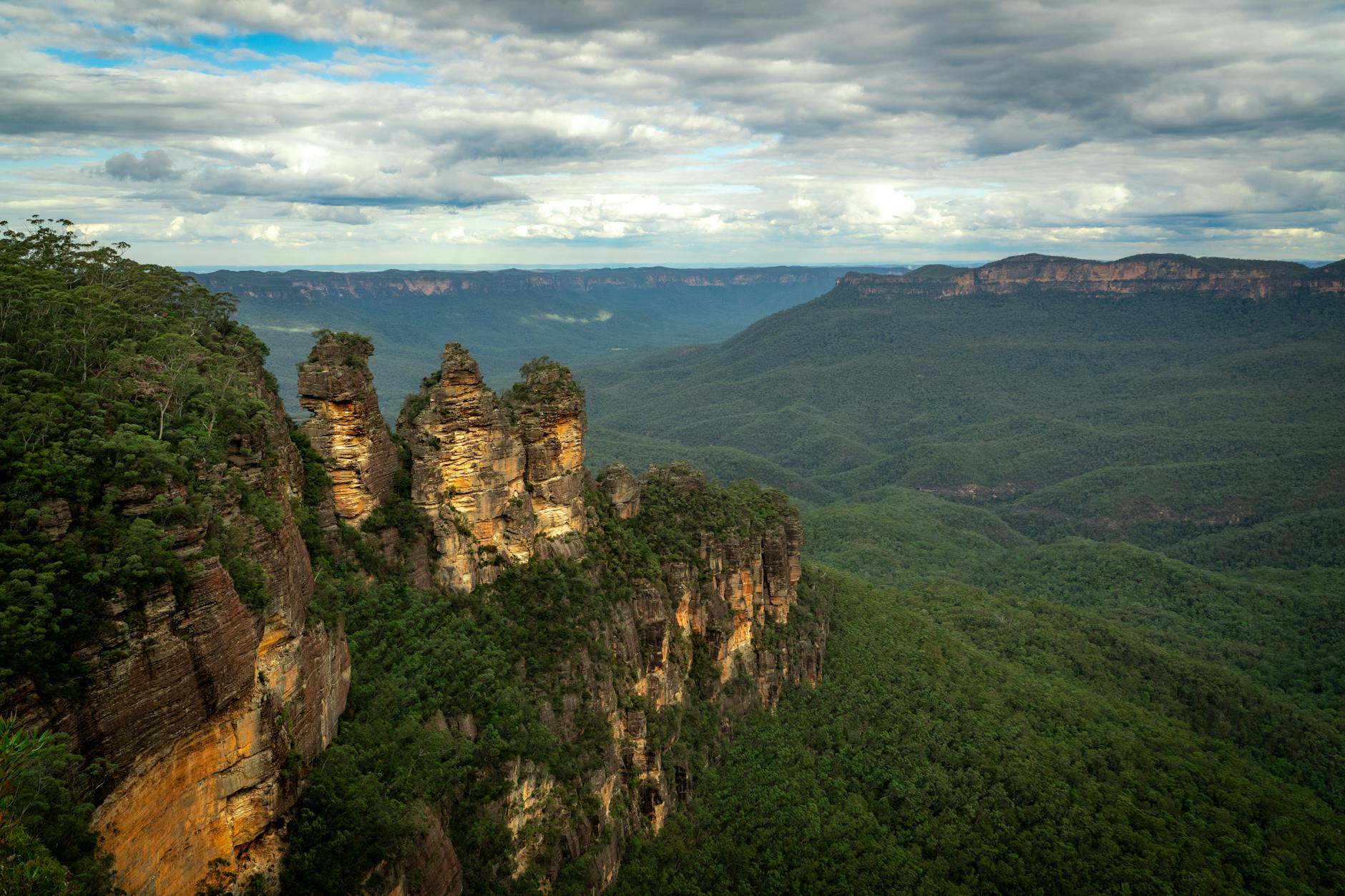
Katoomba station: Train and platform at Katoomba Station by Grendelkhan, CC BY-SA 4.0, via Wikimedia Commons.